

24/7 Broadcast Network Operations Center (NOC)
The centralized broadcast NOC infrastructure powering BMG’s live production, cloud-based TV playout, media workflows, and enterprise content operations — monitored and supported around the clock.
To ContentThe Operational Backbone of BMG’s Broadcast Ecosystem
BMG’s Broadcast Network Operations Center is a purpose-built, always-on operations facility located in Washington, D.C. It is the central hub for all routing, monitoring, ingest, playout, and transmission across BMG’s nationwide productions and managed service clients.
At the core of the facility is the BMG Cloud Control Center™ — a private broadcast cloud where signals are processed, switched, monitored, and distributed. From here, BMG’s engineering and operations teams support live events, multi-channel playout, enterprise communications, REMI productions, and asset workflows for clients in every major industry.
Signals from studios, mobile units, corporate offices, field crews, and remote contributors all terminate here, where they are monitored, protected, and managed under continuous 24/7 oversight.
The NOC is built for one purpose: Keep clients on-air, secure, and operational — no matter where the content originates.
Network Operations Center Flythrough
Take a Virtual Tour of Broadcast Management Group’s Network Operations Center (NOC)
What the Broadcast NOC Delivers
What it is: IP, fiber, satellite, bonded cellular, and private network intake from any global source.
Why it matters: Your content reaches the NOC no matter where it originates — with redundancy across every transport path.
What it is: Continuous human and automated monitoring across live feeds, channels, and productions.
Why it matters: Issues are identified and mitigated in real time — protecting your broadcast, your executives, and your audience experience.
What it is: Full visual, audio, and technical QC for live programs, playout, ingest, and archived assets.
Why it matters: Every frame meets broadcast and enterprise requirements, reducing risk and ensuring accuracy, consistency, and brand integrity.
What it is: Virtualized routing and signal processing inside the Cloud Control Center™.
Why it matters: Scale instantly without on-prem hardware — ideal for multi-channel operations, hybrid events, and enterprise expansions.
What it is: Centralized oversight for playout, automation, SCTE signaling, and distribution.
Why it matters: Channels run cleanly, on schedule, and with broadcast-grade supervision.
What it is: Real-time ingest, logging, archiving, metadata verification, and retrieval workflows.
Why it matters: Your assets are properly stored, organized, and retrievable — eliminating duplication and lost media.
What it is: Redundant routing, alternate feeds, automated failover, and DR orchestration.
Why it matters: Your programming stays on-air even during outages, facility failures, or unexpected disruptions.
What it is: Central management for dozens of simultaneous shows, channels, and enterprise events.
Why it matters: You gain a single operational model across all locations — simplifying workflows and reducing risk.
What it is: NOC-connected control rooms and cloud workflows power remote and hybrid productions.
Why it matters: Every show — remote, studio, or on-site — runs through the same reliable, monitored backbone.
What it is: Standardized runbooks, redundant monitoring, and documented escalation paths.
Why it matters: Your entire video ecosystem operates predictably, reliably, and at broadcast-grade quality.
Client Benefit of Broadcast NOC
The NOC gives clients:
- Higher uptime and operational resilience.
- Consistent quality across all live and on-demand workflows.
- Centralized oversight for every signal and asset.
- Reduced internal staffing requirements.
- Scalable infrastructure without capital investment.
- Faster operational response during live events.
- A standardized, repeatable operational model across all locations.
The result is a unified, enterprise-grade broadcast backbone that scales with your programming, your teams, and your long-term growth.
Washington Broadcast Center Studios – 62,000 sp ft. Interactive Floorplan
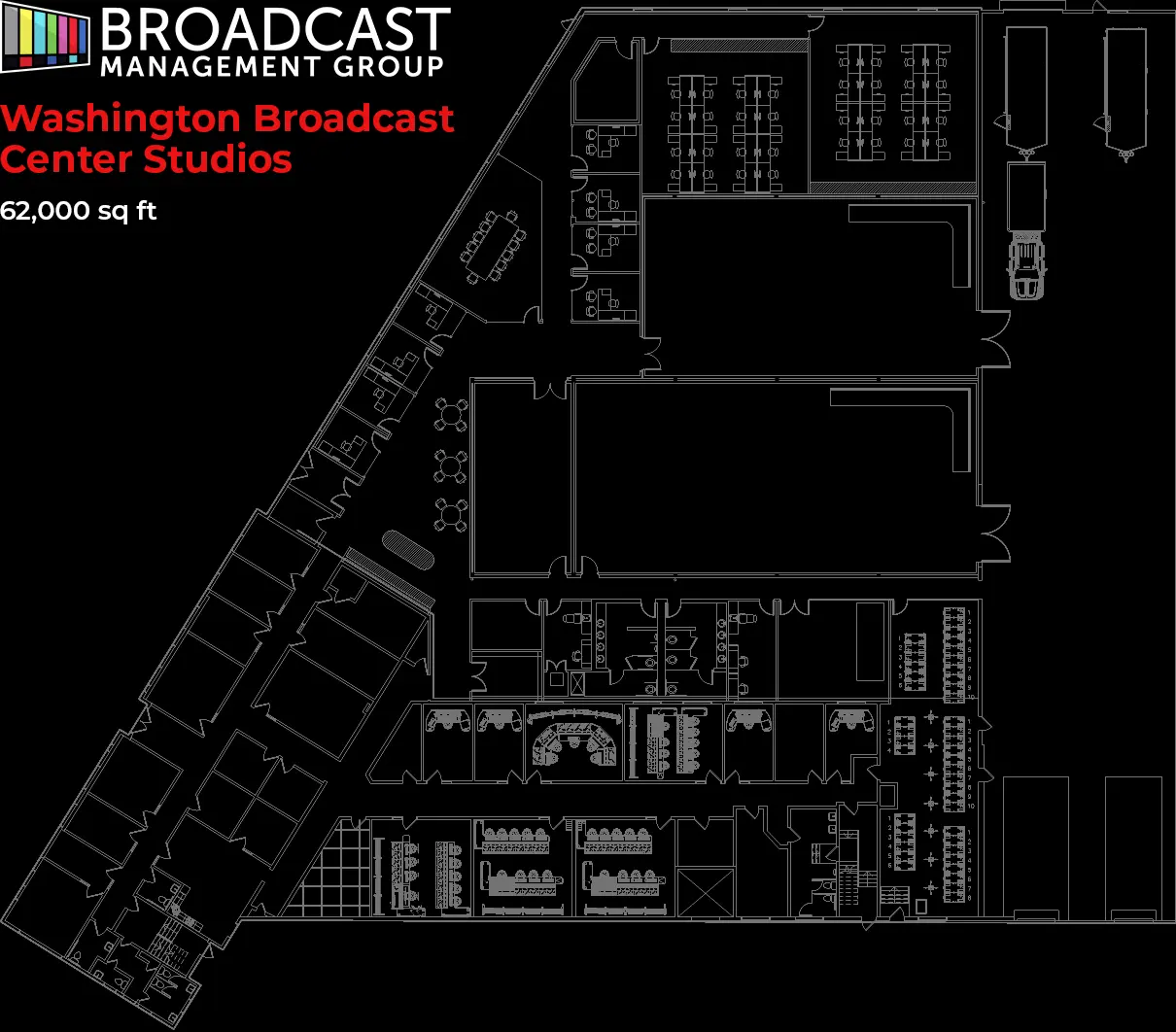
Corporate Offices
This is where BMG’s corporate, production, engineering, and operations teams plan and coordinate projects across the country. From pre-production through execution, teams work together to align logistics, staffing, and technical workflows. It’s the starting point for every production BMG supports.
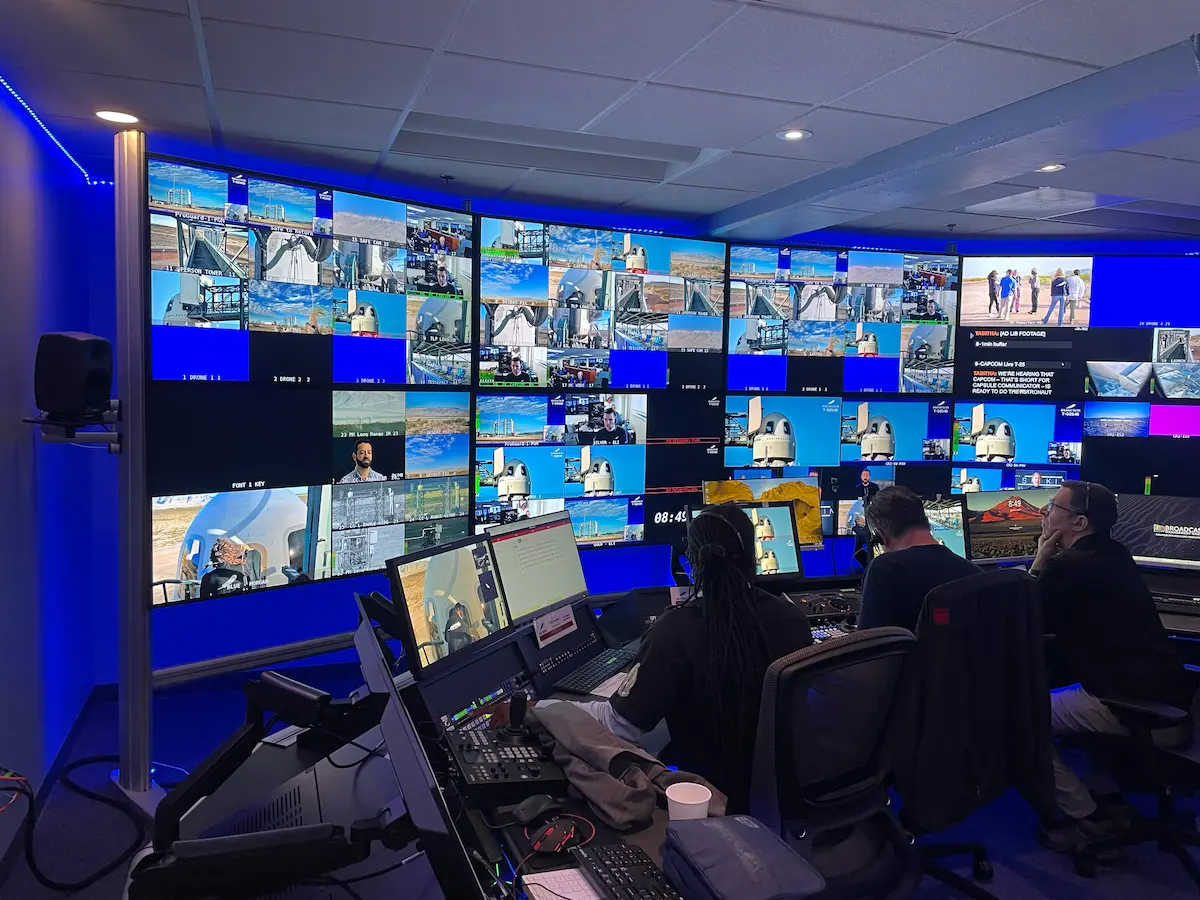
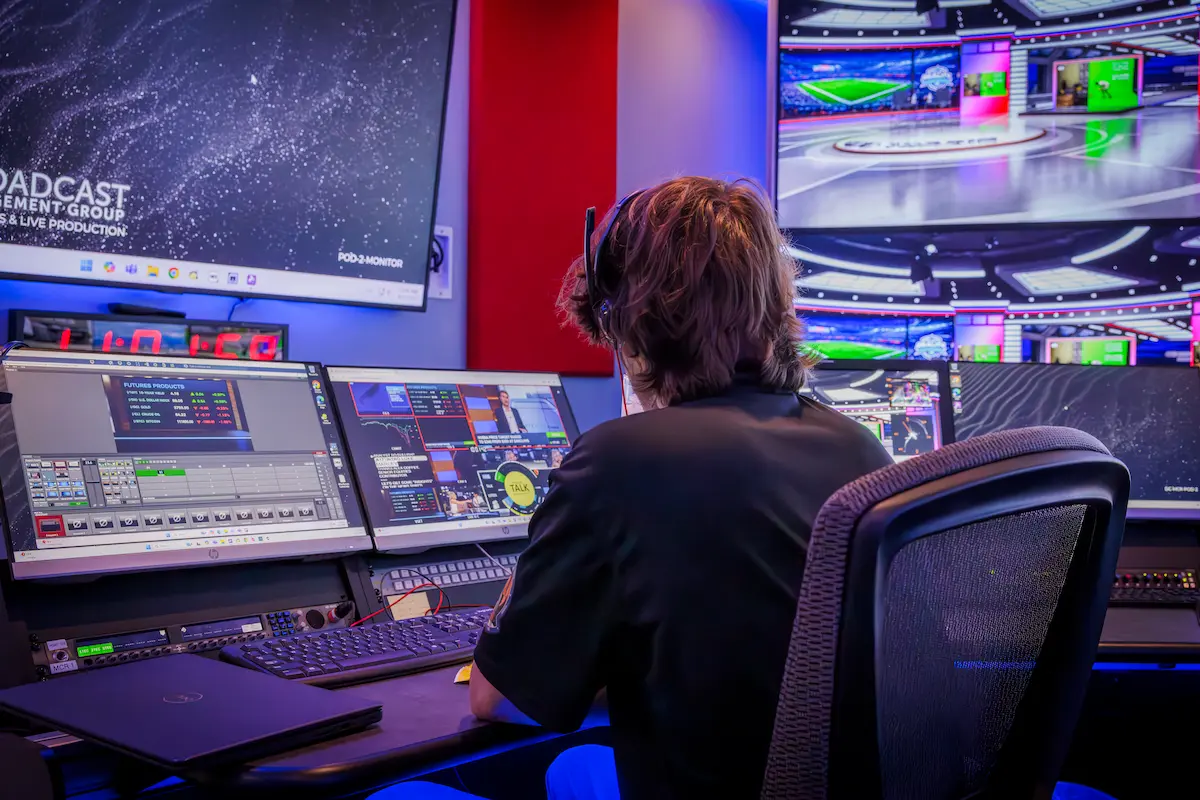
Production Control Room 1
This is one of BMG’s primary production control rooms, where live shows are switched, monitored, and produced in real time. Teams manage video, graphics, and replay from a single, centralized environment. Built around REMI workflows, this room allows productions happening anywhere in the country to be controlled from one location. It’s how BMG delivers complex, multi-location broadcasts with consistency and control.
Technical Overview
Designed for high-complexity live productions and multi-source workflows.
- Production switcher: Grass Valley Kayenne (9 M/E, 54 keyers)
- Graphics: Ross XPression (real-time 2D/3D)
- Replay: Vizrt 3Play 3P2 system
- Record/Playback: Ross Tria
- Routing: Evertz router system
- Intercom: RTS KP panels
- Format: 1080p/60 HDR
Production Control Room 2
This control room expands BMG’s ability to produce multiple live events at the same time. Operators manage switching, graphics, replay, and communications with the same level of control as a traditional on-site truck. By centralizing production here, teams can scale quickly without duplicating resources across locations. It allows BMG to handle overlapping events, large schedules, and rapid turnarounds.
Technical Overview
Built to support concurrent productions and flexible scaling.
- Production switcher: Grass Valley Kayenne (4 M/E)
- Graphics: Ross XPression system
- Replay: Vizrt 3Play
- Record/Playback: Ross Tria
- Routing: Evertz router system
- Intercom: RTS KP panels
- Format: 1080p/60 HDR
Production Control Room 3
This control room is designed to connect directly into client-owned facilities and remote production environments. Using BMG’s cloud-based workflows, teams can operate, monitor, and support productions without being physically on-site. It enables real-time collaboration between locations while keeping production centralized. For clients, that means more flexibility, fewer travel demands, and consistent production quality.
Technical Overview
Optimized for cloud-connected and client-integrated workflows.
- Production switcher: Ross Acuity (4 M/E)
- Graphics: Ross XPression system
- Replay: Vizrt 3Play
- Record/Playback: Ross Tria
- Routing: Evertz router system
- Intercom: RTS KP panels
- Format: 1080p/60 HDR
Audio Control Room 1
This is one of three ACRs in the NOC where all audio for live productions is mixed, monitored, and delivered. Engineers manage everything from microphones and commentary to music, effects, and surround sound output. With dedicated audio control separate from video production, teams can maintain consistent, high-quality sound across every show. It ensures broadcasts sound as polished and reliable as they look.
Technical Overview
Built for broadcast-quality audio mixing and monitoring.
- Audio console: Yamaha DM7 (5.1 surround)
- Monitoring: SPL surround monitor controller
- Playback systems
- Noise compression system
- Intercom: RTS KP panel
Audio Control Room 2
This is one of three ACRs in the NOC where all audio for live productions is mixed, monitored, and delivered. Engineers manage everything from microphones and commentary to music, effects, and surround sound output. With dedicated audio control separate from video production, teams can maintain consistent, high-quality sound across every show. It ensures broadcasts sound as polished and reliable as they look.
Technical Overview
Built for broadcast-quality audio mixing and monitoring.
- Audio console: Yamaha DM7 (5.1 surround)
- Monitoring: SPL surround monitor controller
- Playback systems
- Noise compression system
- Intercom: RTS KP panel
Audio Control Room 3
This is one of three ACRs in the NOC where all audio for live productions is mixed, monitored, and delivered. Engineers manage everything from microphones and commentary to music, effects, and surround sound output. With dedicated audio control separate from video production, teams can maintain consistent, high-quality sound across every show. It ensures broadcasts sound as polished and reliable as they look.
Technical Overview
Built for broadcast-quality audio mixing and monitoring.
- Audio console: Yamaha DM7 (5.1 surround)
- Monitoring: SPL surround monitor controller
- Playback systems
- Noise compression system
- Intercom: RTS KP panel
Master Control & Transmission
This is where channels are managed, monitored, and kept on-air 24/7. The team oversees playout, signal integrity, and distribution across linear, FAST, and OTT platforms. With automated workflows and constant monitoring, issues are identified and resolved before they impact viewers. It allows clients to operate full-time broadcast channels without building their own infrastructure.
Technical Overview
Built for continuous playout, global distribution, and high channel density.
- Platform: Grass Valley AMPP (cloud-based playout)
- Channel origination and automation systems
- Multi-channel ingest and distribution workflows
- Fiber connectivity across multiple providers
- Transmission systems: LiveU, TVU, LTN, satellite paths
- Encoding/decoding across multiple formats
- Redundant infrastructure and monitoring systems
Data Center
This is the core of BMG’s Network Operations Center, where all systems, signals, and workflows are connected. Technology is centralized here so production teams can operate from anywhere without losing control or visibility. It powers REMI workflows, cloud-based production, and real-time collaboration across multiple locations. By keeping infrastructure in one place, BMG reduces on-site footprint while increasing reliability and scalability.
Technical Overview
Centralized infrastructure supporting REMI, cloud production, and facility integration.
- Evertz EQX routing system
- Grass Valley K-Frame XP switchers
- AMPP cloud production platform
- Integrated MAM and transmission workflows
- RTS Odin intercom systems
- Multi-site connectivity across BMG facilities
- Centralized support for client-owned infrastructure
Video Shading Room
This is where camera feeds are adjusted and matched to ensure consistent visual quality across every shot. Engineers remotely control exposure, color, and shading for cameras across multiple locations. Because shading is centralized, teams can maintain a uniform look even when cameras are deployed in different venues. It’s a critical step in delivering a clean, professional broadcast image.
Technical Overview
Centralized control for consistent camera shading across productions.
- Grass Valley creative grading control panels
- CCS control server
- Multi-camera shading support
- Remote shading capabilities across locations
Studio A
Studio A is designed for interviews, executive messaging, and digital-first content. Designed for financial updates, remote guest segments, and corporate video production. The space supports both physical and virtual set environments, allowing teams to adapt the look without rebuilding the studio. It’s optimized for fast, efficient productions with a smaller on-site footprint.
Studio Details
Built for interview-driven and digital production workflows.
- Size: 807 sq ft
- Dimensions: 20’ x 40’
- Lighting Grid: 14 ft
- Supports: Interviews, remote guests, virtual production
Studio B
Studio B is BMG’s largest studio, built for multi-camera productions and audience-based programming. It supports talk shows, sports panels, political roundtables, and large-scale live broadcasts. The space can be configured for complex set designs while remaining fully connected to the control rooms and NOC. It’s designed to handle high-volume productions and recurring broadcast series.
Studio Details
Designed for large-scale, multi-camera productions and audience-based programming.
- Size: 3,341 sq ft
- Dimensions: 84’ x 40’
- Lighting Grid: 14 ft
- Supports: Talk shows, panels, audience formats, virtual sets
Studio C
Studio C is a flexible production space used for news, sports, and multi-camera streaming broadcasts. It supports a wide range of programming, from financial coverage to town halls and live events. Like all BMG studios, it connects directly into centralized production workflows. This allows teams to scale productions up or down without changing the core setup.
Studio Details
Flexible studio for mid-size productions and live broadcasts.
- Size: 2,627 sq ft
- Dimensions: 69’ x 40’
- Lighting Grid: 14 ft
- Supports: News, sports, streaming, town halls
Studio D
Studio D is built for interview-driven and panel-based productions. Built for political coverage, corporate broadcasts, and live commentary. The space supports quick transitions between segments, making it ideal for fast-paced programming. It’s also used for satellite media tours and live shot productions.
Studio Details
Optimized for panel discussions, interviews, and rapid-turn productions.
- Lighting Grid: 14 ft
- Supports: Panels, commentary, satellite media tours, live shots
- Configurable for virtual and physical sets
Newsroom
One of two newsrooms, this space is designed to support fast-paced content creation and live updates. Teams can prepare scripts, coordinate segments, and manage information in real time. Connected to the rest of the facility, it allows news-style productions to move quickly from planning to broadcast. It’s built for speed, coordination, and constant communication.
Makeup Room
This is where on-air talent prepares before going into the studio. The space is designed to support quick turnarounds between segments and productions. Located close to the studios, it ensures talent can move efficiently from preparation to broadcast. It helps keep productions running on schedule without delays.
Staff Kitchen & Catering Area
This space supports crews and staff working long production hours. It provides a central area for meals, breaks, and catering during live events. Designed for efficiency, it helps keep teams on-site and focused during extended productions. It’s a small but important part of maintaining smooth operations.
Warehouse – Mobile Unit Side
This area houses BMG’s mobile production units and field equipment. Crews stage, prep, and deploy gear for productions happening across the country. Because these units connect directly back to the NOC, they integrate seamlessly into centralized workflows. It allows BMG to support both on-site and remote productions at scale.
Warehouse – System Integration Side
This is where BMG designs, builds, and tests broadcast systems for ourselves and clients. Teams assemble control rooms, studios, and infrastructure before deployment to client facilities. Every system is tested here to ensure it performs reliably once installed. It’s where BMG’s system integration work comes to life before going into the field.
See How the NOC Fits Into Your Workflow
If you’re managing live production, channels, or content workflows, we can show you how centralized monitoring and control can improve reliability and scale.
Gravity Forms Privacy Policy and Terms of Service apply.
"*" indicates required fields
Ready to get started?
Connect with us to discuss your project and get a quote. We'll get back to you as soon as possible.
"*" indicates required fields