Executive Summary:
- Universities build broadcast-grade sports studios by integrating control rooms, venue connectivity, camera systems, graphics, replay, REMI workflows, and media asset management into one scalable production environment. The goal is to support multiple sports, simultaneous events, student crews, and reliable distribution of linear, streaming, and social content.
- A university sports production studio becomes broadcast-grade when it is designed as an integrated media operation rather than a collection of equipment. That means planning for multi-venue workflows, centralized production, student-operator usability, fiber and routing infrastructure, and content archiving that support recruiting, streaming, and long-term growth.
- To build a broadcast-grade video production studio for university athletics, schools need more than cameras and switchers. They need a system built for multi-sport scheduling, REMI production, scalable control rooms, documented workflows, and fast clip distribution so content can reliably serve conference partners, social channels, recruiting, and NIL needs.
Industry Context: College athletics media rights have become a significant revenue category for universities. Conference distribution deals, school-owned streaming channels, and NIL-adjacent commercial production have transformed the athletic department from a cost center into an active media operation and revenue stream. The programs positioned to capture that value are the ones that have built real production infrastructure, not just added cameras and equipment.
University athletics programs increasingly produce and distribute their own content, independent of traditional network agreements.
Student-athletes, NIL expectations, streaming platforms, conference agreements, and recruiting demands have created a new reality: universities need to produce broadcast-quality video in-house across linear, digital, and social channels at scale and on schedule.
The programs doing it well are generating content that drives recruiting, satisfies conference distribution partners, and builds brand equity season after season. The programs doing it poorly are producing content that limits what the department can offer partners, conferences, and athletes.
There’s a big difference between having cameras and having a production studio. That gap usually comes down to systems integration, not just budget.
University athletic broadcast productions often have multiple linear and digital partners, serve in-house game presentation displays, and simultaneously meet the needs of sponsorship, marketing, NIL programs, and alumni relations. Each need may require a different solution based on priorities or budgets; however, each system must integrate seamlessly into an overall ecosystem for content sharing and distribution.
Facility design decisions establish the long-term capabilities of the production operation. Addressing integration requirements at the outset is significantly more cost-effective than implementing retrofits after initial deployment.
Why University Sports Broadcasting Is a Different Problem Than Commercial TV
The Multi-Sport, Multi-Venue Constraint
Commercial broadcast facilities are often built around repeatable workflows. Same studio. Same signal path. Same format.
A university sports production environment must serve football, basketball, baseball, soccer, wrestling, and sometimes many more, often across different physical locations, with much of the same staff and equipment.
Universities are often aware of the specific needs of each venue individually: football, basketball, baseball, presentation and concert halls, and classroom productions. What they frequently underestimate is the demand for simultaneous coverage.
Universities commonly schedule events like basketball and wrestling, or baseball and tennis, concurrently. When multiple events need coverage at the same time, having the right gear isn’t enough. The system has to be designed to run multiple productions at once.
Broadcast Management Group (BMG) brings up these questions during the consultation phase, which correctly requires strict analysis before a single purchase order is signed:
- Is it one control room, or three?
- Does each control room need the same level of production capability?
- What resources can be shared between control rooms?
- How do budgetary goals constrain or shape each answer?
Signal routing, fiber infrastructure, and control room architecture must be designed with multi-venue flexibility built in from day one, not added as a second phase when the budget has already been committed.
The Student Operator Reality
Many university productions are crewed, at least in part, by students, whether as part of a broadcast journalism program, an athletics communications team, or an internship.
A studio designed for professional operators with years of muscle memory is not the same as a studio designed to produce consistent results when the technical director is a senior who will graduate in May. The constant training and recycling of student operators creates a real impact on what the technology can deliver and raises an essential operational question.
One of the first questions to answer is simple: how much training and oversight can the university realistically support?
The design answer is to find solutions that enable student-run, professionally built systems capable of serving multiple tiers of show production.
Every studio includes organizational must-haves: labeled signal paths, intuitive routing, and pre-built show templates that reduce human error under live conditions.
Broadcast Management Group (BMG) then identifies the right control surfaces for students to learn on, so that when experienced professionals are brought in, production can be elevated to fully meet broadcast network expectations.
Budget Cycles Don’t Match Production Schedules
University budgets move on one timeline. Production schedules move on to another.
BMG approaches every project with a planned lifespan of five to seven years, a horizon that aligns with normal depreciation cycles and technology replacement timelines. More importantly, that kind of long-term planning accounts for upgrades and additions, both expected and unexpected.
Thinking about scalability from the outset eliminates the need for a complete rip-and-replace as needs evolve. Whether the growth is a new venue, an additional control room, or an expanded conference distribution obligation, a well-designed system accommodates it without requiring a complete restart.
The goal is always a solid foundation that can be built upon as the program’s ambitions and obligations grow. Many clients don’t realize how much future flexibility can be built into the first phase of the design.

Core Systems Every University Sports Studio Requires
Production Control Room (PCR) Design
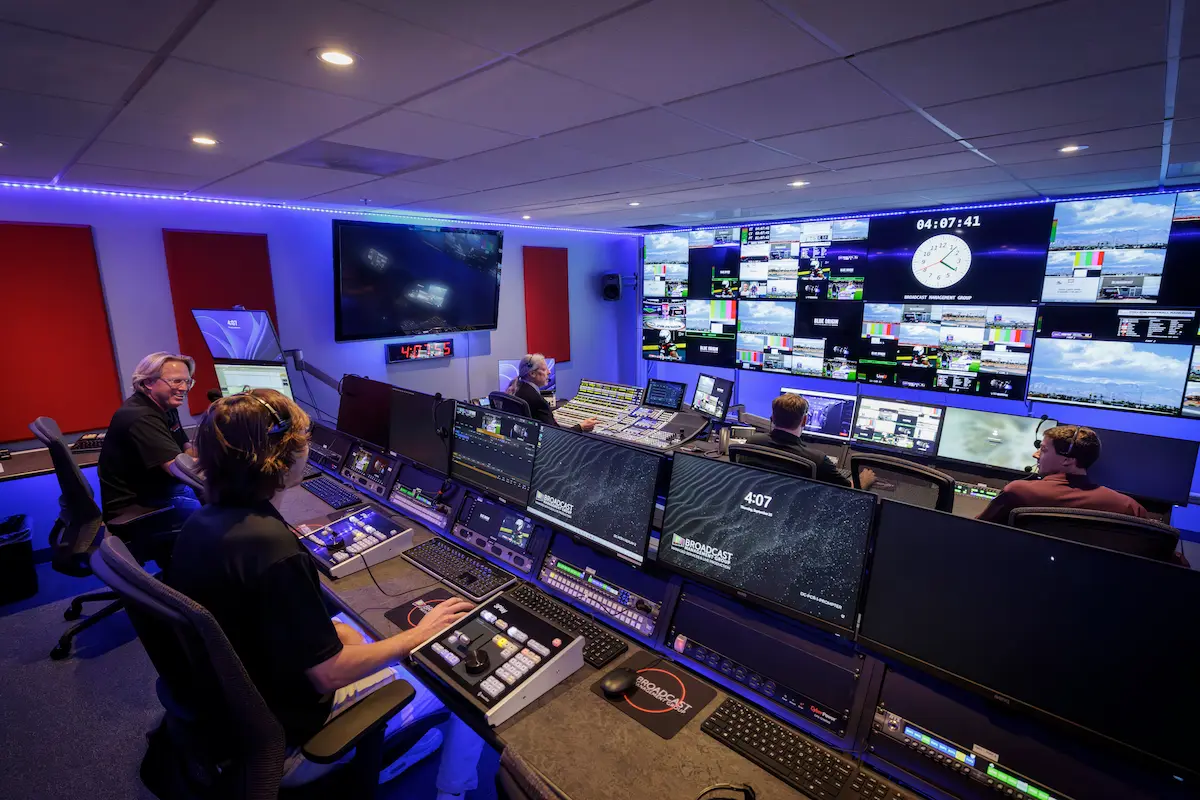
The PCR is the operational nerve center. Switcher, audio console, replay system, graphics engine, and intercom must be selected and sized to match the full scope of productions the department intends to run, not just the smallest or most modest event on the calendar.
If a production scenario is likely, the system should account for it early. That might mean on-prem infrastructure, cloud-based burst capacity, or a pay-as-you-go model that keeps options open without overbuilding on day one.
Overconfigured PCRs are expensive and intimidating. Underconfigured PCRs create workarounds that degrade show quality and increase operator stress under live conditions.
For a Division I program, collegiate sports production covering football, men’s and women’s basketball, baseball, softball, volleyball, wrestling, and soccer, realistically eight to ten sports at a production level, a well-configured PCR needs flexible operability. It must be capable of assigning additional resources to primary sports during flagship productions while simultaneously providing coverage for smaller digital or ad-served productions.
A solid routing backbone for graphics, replay, audio switching, communications, and monitoring means every show is properly served and every sport feels supported at a level commensurate with its audience.
Signal Routing, Infrastructure & Fiber
Signal flow is where many studio projects succeed or fail. Effective planning is required to ensure reliable transmission of video and audio signals between venues, cameras, production equipment, and output destinations, including streaming encoders, broadcast feeds, and recording systems.
There is no one-size-fits-all infrastructure model for universities. Quality solutions exist across many protocols, and each can support a school’s specific production needs in different ways. IP-based signal infrastructure (SMPTE ST 2110) and traditional SDI both have valid roles. One principle always applies: whatever backbone you choose, you must train and provide the right engineering support for live productions.
ST 2110 requires more expertise and stricter operational discipline than conventional SDI. The right choice depends on your operating environment, budget, in-house technical skills, and the engineering support you can secure on production days.
Camera Systems & Field Positions
The number and location of cameras and the cabling/wireless infrastructure connecting them to the PCR must be planned sport by sport.
Football doesn’t need the same coverage as volleyball. Baseball doesn’t need the same lensing or camera plot as basketball.
BMG’s experience across primary, secondary, Olympic, and niche sports enables a well-considered camera configuration that can support a ten-camera linear production or a two-camera stream with equal intention.
Robotic camera systems are increasingly utilized in university productions with limited crew resources. These systems provide enhanced production capability for both large-scale and smaller events, enabling broadcast-grade coverage for secondary sports that may not justify a full field crew, and delivering professional results without proportional increases in staffing costs.
Graphics, Replay & Streaming Playout
Insert graphics, scorebug, and highlight-replay systems are now accessible to universities at budget-friendly price points. However, effective integration planning is required to ensure reliable on-air performance.
For graphics, Xpression provides schools with significant flexibility in graphics production, scorebug, and switching element workflows. Careful attention to integration methods, internal networking, and connectivity is critical to harnessing the full capability of a machine that serves insert elements, scores, and switches graphics simultaneously.
BMG approaches vendor selection as agnostically as possible; the right tool is the one that fits the mission and the budget, not the brand.
Replay platforms are equally varied. EVS platforms offer robust slow-motion capabilities, networking, and easy archiving for high-end productions.
DreamCatcher has made significant strides over the past decade with unique configurations and a more accessible price point. Ross, Vizrt, Sony, Grass Valley, and others all offer viable solutions across a wide range of budgets. The right selection depends on operational need, not vendor loyalty.
For streaming delivery, encoders are typically provided by the conference network or distribution partner rather than by the production team. The university’s primary obligation is to understand its specific conference or distribution requirements and ensure that the infrastructure supports clean, redundant signal delivery to the entity that provides the encoding layer.

Integration Is the Product — Not the Equipment
A List of Gear Is Not a System
Universities frequently receive proposals from equipment vendors that are essentially bills of materials, a list of cameras, switchers, and monitors without a signal flow document, a rack layout, or a commissioning and training plan.
If the system isn’t integrated, it won’t work on-air, no matter how good the individual pieces are.
The total cost of a broadcast facility includes design, integration labor, cabling, commissioning, operator training, and documentation, not just hardware. As a practical benchmark, engineering design and systems integration, including commissioning, often represent 30 to 35 percent of the overall project budget.
The remaining 65 to 70 percent is technology. This ratio is almost universally underestimated at the RFP stage, when clients compare hardware line items without accounting for the engineering work required to turn a parts list into a functioning broadcast system.
Proposals that ignore this ratio are not competitive bids; they are incomplete ones and could lead to higher costs in the future.
Documentation & Training as Infrastructure
The studio that runs smoothly three years after opening is the one where the signal flow is documented, the show templates are maintained, and every operator, student, or staff member can be onboarded from a written standard. Documentation is not a deliverable that comes after the project is done. It is infrastructure, in the same category as fiber and power.
BMG looks at every build as a production partnership. Engineering support is always a component of the project because ultimately, it is the school that runs the facility. Full technical support and documentation are required not only for current use but also for the future growth of the athletics production operation.
With our extensive production background and a well-planned studio build, operator development is built into every engagement. The goal is for Day 1 productions to meet or exceed conference and audience expectations, which requires that the people running the system understand it, not just those who built it.
BMG delivers as-built drawings at the completion of every integration project, documenting each rack and piece of equipment and providing the institution with a foundation for onboarding future operators and supporting future expansions.
REMI Production — Extending Coverage Without Adding Crew
What REMI Means for University Athletics
REMI lets a university capture cameras and audio at the venue, then produce the show from a centralized control room on campus or off-site.
For a university with ten to twenty sports across multiple venues, REMI is not a cost-cutting measure. It is the operational model that makes consistent broadcast-quality production achievable at scale. As a practical matter, when a university builds a central production control room and connects multiple venues to it via fiber, every one of those venues is effectively a REMI production.
Once two venues are feeding one control room, you are already thinking in a REMI model. The control room becomes the hub. The venues become the spokes.
Flypacks remain an option, but they share the same core limitation as a traditional truck: they can only service one venue at a time.
With a REMI architecture, a centralized PCR can support a wrestling event in the afternoon and a basketball game in the evening, which is exactly the kind of scheduling reality universities face every week of the athletic calendar. This is why designing around a centralized production solution from the beginning is almost always the operationally rational choice.
REMI Infrastructure Requirements for a Campus Build
REMI-capable infrastructure requires fiber connectivity between each venue and the PCR, a reliable IP-based intercom system, remote camera control capability, and an encode/decode layer that maintains broadcast-quality video over the return path.
Fiber is the foundation, and its importance extends beyond the main signal trunk. Power, camera positions, and audio flow must be considered not only between each venue and the central studio but also within each venue. Infrastructure gaps at the venue level can hamper an entire production, regardless of how well configured the central PCR is.
Campus fiber runs, IP encode/decode gear, and intercom over IP are the infrastructure decisions that enable REMI production, and they must be planned for during initial systems integration, not added as an afterthought when the first scheduling conflict reveals the gap.
REMI and the Student Operator Model
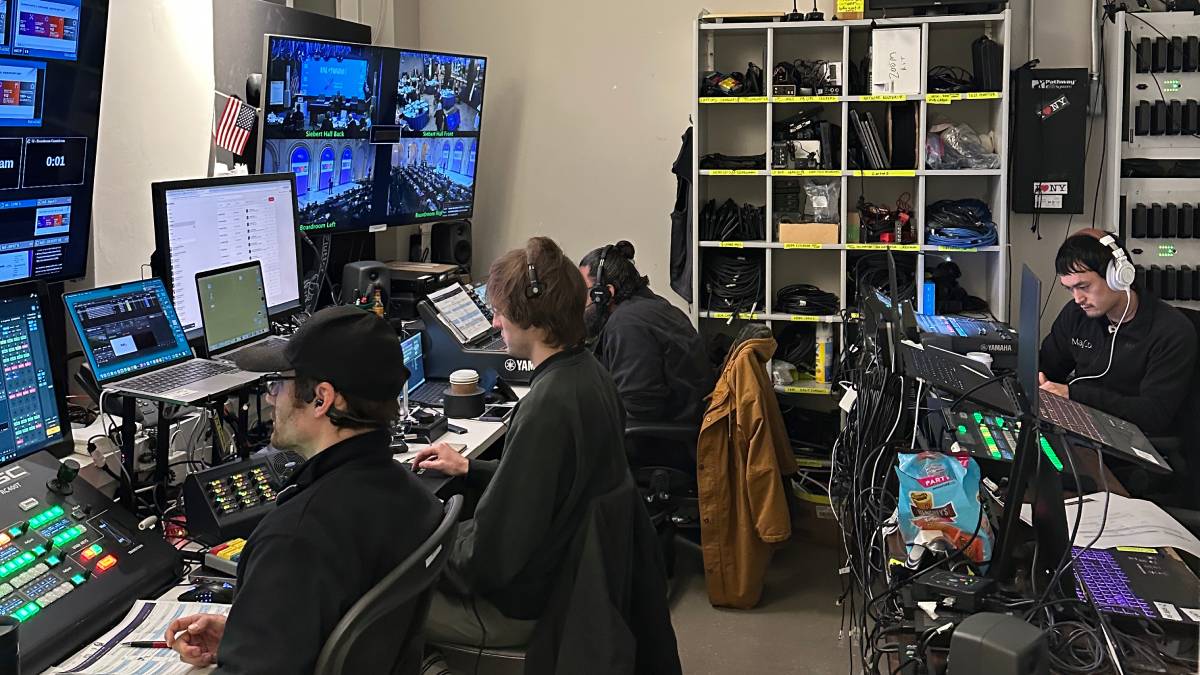
REMI is particularly well-suited to the student-crew model. A trained technical director, A1 director, or producer, along with an engineering position, can run the PCR centrally while student operators manage cameras in the field with lighter supervision. This allows a smaller, more experienced core team to maintain consistent quality across more events per week, a significant operational advantage during a full fall or spring athletic season.
BMG’s experience as a packager for collegiate events across large and small markets has uncovered a wide range of technical crew skills and experience in REMI environments. Having the core team approach each production not only with quality in mind but also through the lens of an advanced learning experience creates a new model for each show. One that develops student operators progressively while sustaining the standards that conference and streaming partners expect from every broadcast.
MAM & Social Clip Distribution — Turning Every Game Into Content
The Asset Management Problem University Programs Face
A university sports program broadcasting across a full academic calendar generates a significant volume of recorded content: raw game footage, highlights, promos, interviews, graphics packages, and archival material. Without a Media Asset Management (MAM) system, this content is stored inconsistently, found inefficiently, and routinely lost to staff turnover.
When Broadcast Management Group (BMG) begins a university athletics engagement, the archive situation often looks the same: a collection of videotape and unorganized or scattered external hard drives, with no searchable metadata, no retention policy, and no one who can reliably locate footage from two seasons ago.
The value of a broadcast studio doesn’t end when the game ends. The content library created by every production and the ability of the entire production team (marketing, digital, social media, game presentations, corporate sponsorships, athletics communications) to access, repurpose, and distribute that library quickly, from anywhere in the office, the venue, home, or the quad via proxy editing and cloud-accessible workflows.
A properly implemented MAM gives every stakeholder in the department’s media operation direct access to the full content universe, without requiring a technical intermediary every time someone needs a clip.
Highlight Clipping & Same-Day Social Publishing
Conference digital rights deals, recruiting coordinators, and fan-facing social channels all demand one thing: clips, fast. A coach wants a highlight reel for a recruiting visit by Monday morning. The social team needs a 60-second reel published by the final whistle.
A MAM-connected workflow — where recorded game footage is ingested, tagged with sport, player, and event metadata, and accessible to a clip editor within minutes of capture — is what makes same-day social publishing operationally viable at volume. Without MAM, clip production is manual, slow, and entirely dependent on whoever happens to know where the files are stored on which drive this week.
Metadata, Search & Reuse
Broadcast value is not just in distribution. It is in reuse.
A recruiting video repurposed from last season’s game footage. A season-opener promo built from archived B-roll. A donor event highlight reel pulled together in hours rather than days. A compliance archive that can be searched by date, player, or event in seconds.
All of this depends on a searchable, metadata-tagged archive that connects the broadcast production system to every downstream use of that content: social, recruiting, marketing, compliance archival, and streaming.
The MAM is the connective tissue that turns every hour of live production into a reusable content asset — and the system that makes the entire investment in a broadcast studio compoundingly more valuable over time. Without MAM, content is often captured once and lost in the archive. With it, every game becomes part of a searchable content library.

NIL, Streaming Rights & the Monetization Case for Doing This Right
University athletic departments are increasingly expected to generate revenue from their media operations through conference distribution agreements, school-owned streaming channels, social media content, and NIL-adjacent commercial production for their student athletes.
The capital investment in broadcast infrastructure is often directly enabled by those distribution agreements. Entities like ESPN, which hold exclusive conference rights to properties like the SEC and ACC, pay the conference, which in turn distributes a production fee to member schools. That fee allows schools to invest in production facilities, which they then use to produce linear, non-linear, and digital networks, such as ACC+ games for ESPN+ or for their own streaming platforms.
The school benefits on both sides: those same facilities serve academic programs, non-sports institutional productions, and campus-wide content operations well beyond game day.
A dedicated NIL content space, connected to the studio and media library, gives schools another way to support recruiting, athlete branding, sponsorship, and revenue goals.
A properly integrated broadcast studio is the infrastructure layer that makes all of that possible. A poorly integrated one is a liability that limits what the department can offer partners, conferences, and athletes.
Build for the Program You’re Becoming, Not the One You Have Today
A university sports broadcast facility is not a one-time purchase. It is the foundation of a media operation that will grow in scope, audience, and commercial complexity across the next decade.
The integration decisions made now — infrastructure design, IP readiness, REMI capability, MAM and social clip workflow, linear and digital distribution architecture — determine whether that growth is frictionless or expensive.
BMG begins every engagement with a clear statement: we are your partner in this project. You can start a consultation with a broadcast systems integration expert. While we have the background and experience to build whatever a university may envision, we have the intuition to see where production spaces and production models are headed, and to provide invaluable insight aligned with institutional goals and long-term vision. We are here to meet your needs, not ours, in that partnership.
That partnership starts with a fundamental question: Do you have a clear operational vision for what this studio needs to do, not just on opening day, but in year three, year five, and year seven? If the answer is yes, we build to that vision. If the answer is still taking shape, that alignment work is where we start.

Dave Weiler is the Senior Vice President of Sports Packaging and Consulting. He leads BMG’s consulting practice, overseeing global consulting projects and building strategic client relationships. A nine-time Emmy Award winner, he brings more than 35 years of leadership experience across media operations, production, and business strategy, including senior roles at ESPN and as founder of Media Edge Consultants. His expertise helps clients develop efficient, scalable solutions across the evolving media landscape.
About Dave Weiler