

The Problem Most Content Teams Don’t See Coming
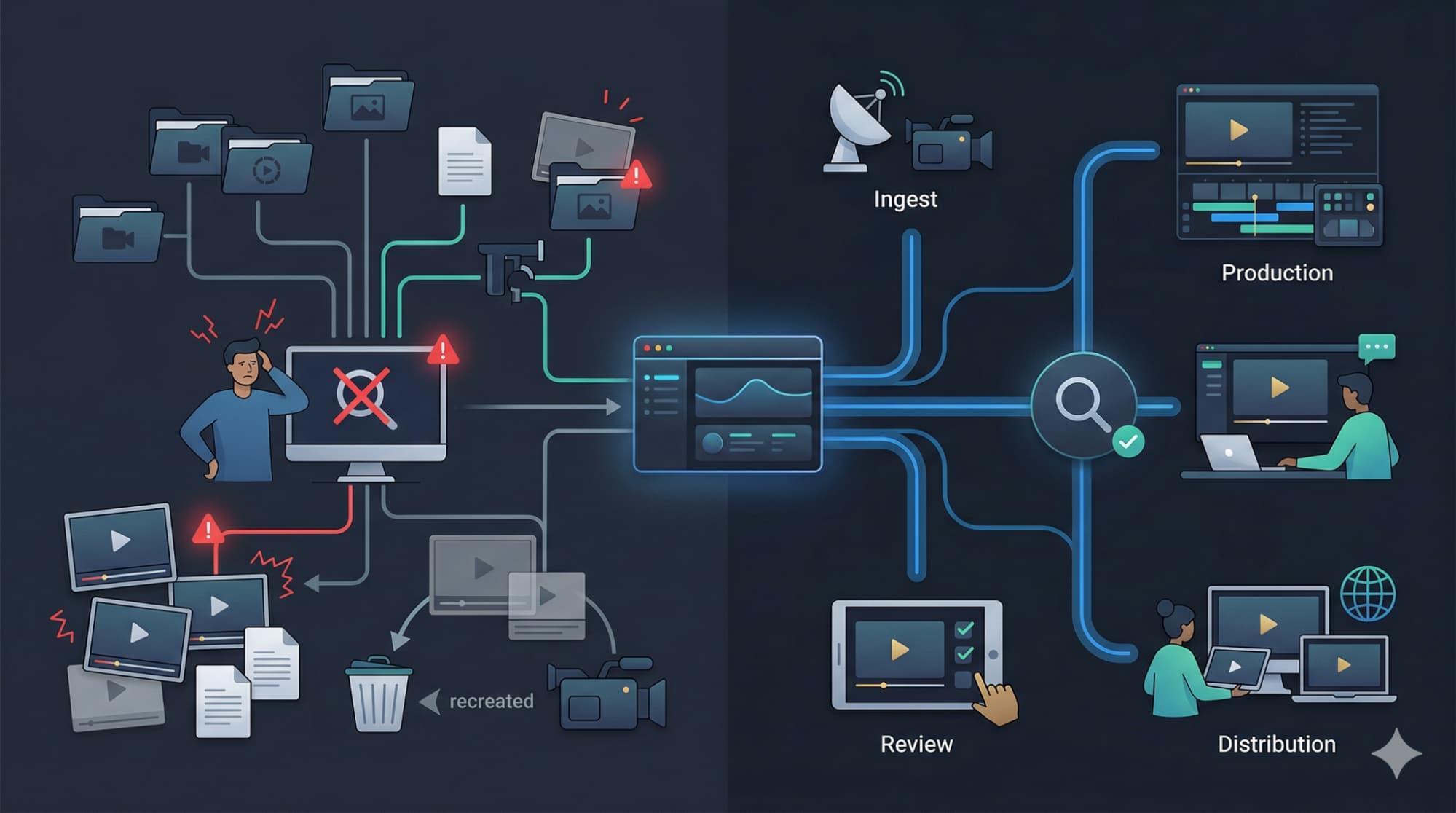
Media asset management usually isn’t a problem at the start.
It builds over time.
A shared drive works when the team is small. A folder structure makes sense when there are only a few projects. Naming conventions hold up when the same people are creating and using the content.
But as volume grows, those systems start to break down.
Editors can’t find what they need. Teams recreate assets that already exist. Versions get mixed up. Distribution becomes inconsistent. Valuable content goes unused because no one knows it’s there.
At that point, it’s not just inefficient. It’s slowing down production.
Time gets spent searching, recreating, and fixing mistakes instead of actually producing content.
A media asset management company solves this by replacing those fragmented systems with structure, visibility, and control. The goal isn’t just to store content. It’s to manage how content moves, evolves, and gets used across the organization.
What Is a Media Asset Management Company?

A media asset management company helps organizations ingest, organize, search, control access to, and distribute their content across its full lifecycle.
This goes beyond providing software.
A MAM system defines how content is structured, how it’s found, who can use it, and how it moves through production and distribution. It connects ingest, editorial, approvals, distribution, and archive into a single operational layer.
Cloud storage is where content lives.
A MAM system determines how that content is used.
That distinction matters.
Without structure, governance, and workflow alignment, even the best platform will just scale inefficiencies.
The value of a media asset management company comes from aligning technology with real operations, making sure metadata is meaningful, workflows are efficient, and systems actually support how teams work day to day.
Why Organizations Need Media Asset Management
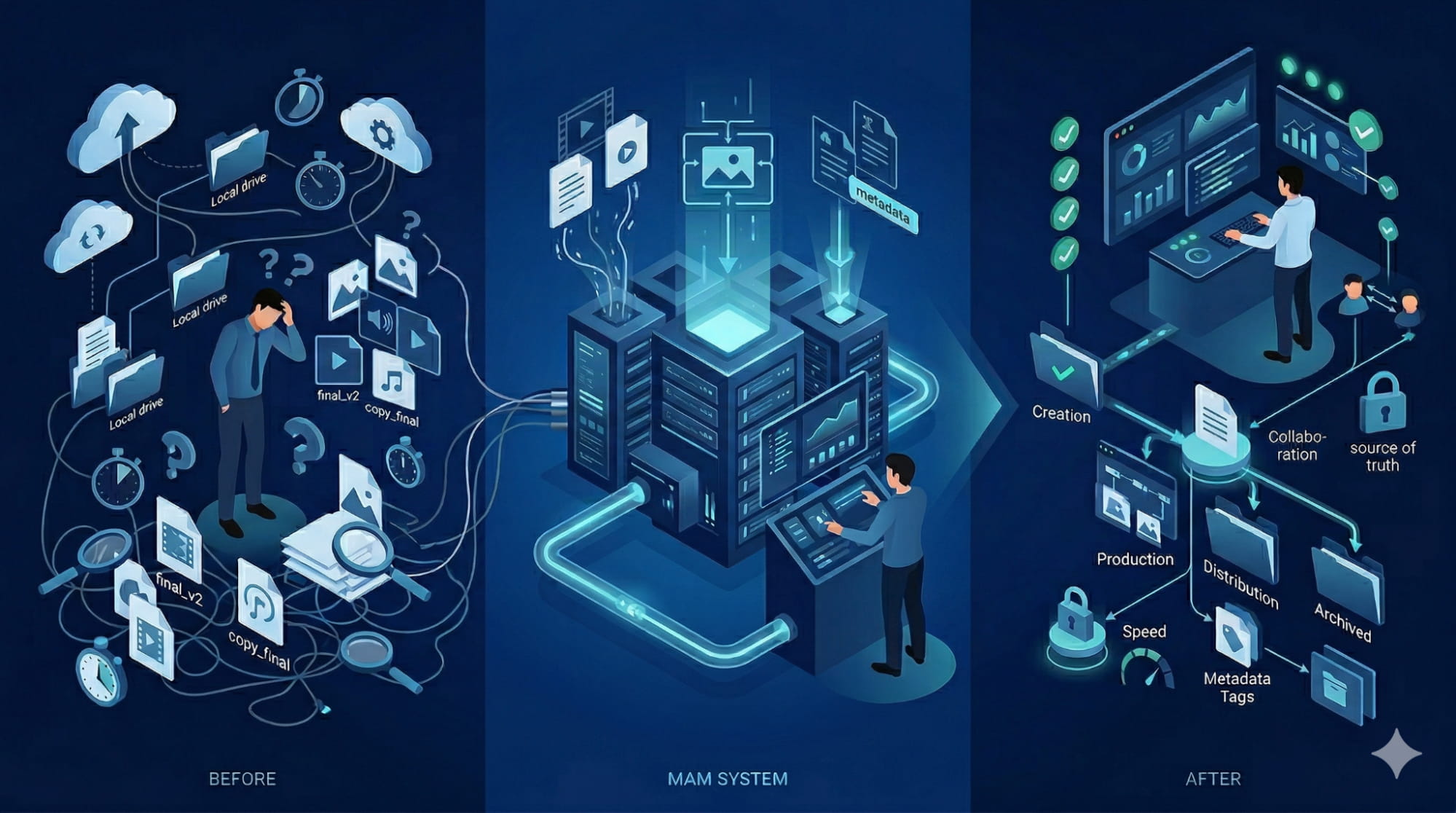
The reasons organizations adopt MAM are consistent across industries.
As content volume grows, informal systems stop working.
Content becomes harder to find. Teams spend more time searching than using what already exists. At scale, that’s not a small issue. It impacts timelines, output, and productivity across the board.
Work gets duplicated. When assets are scattered across drives and platforms, teams recreate content that’s already been produced.
There’s no single source of truth. Content lives in multiple places, and access depends on who remembers where something is stored.
Version control breaks down. Multiple versions circulate without clear ownership, leading to delays and mistakes.
Rights and compliance become harder to manage. Without visibility, it becomes difficult to track usage rights and restrictions.
A media asset management company addresses these challenges by introducing structure, centralized control, and defined workflows. The goal is simple: make content accessible, usable, and reliable at scale.
What to Look for in a Media Asset Management Company
When evaluating a media asset management company, the focus should be on how well the system supports real production workflows, not just technical specifications.
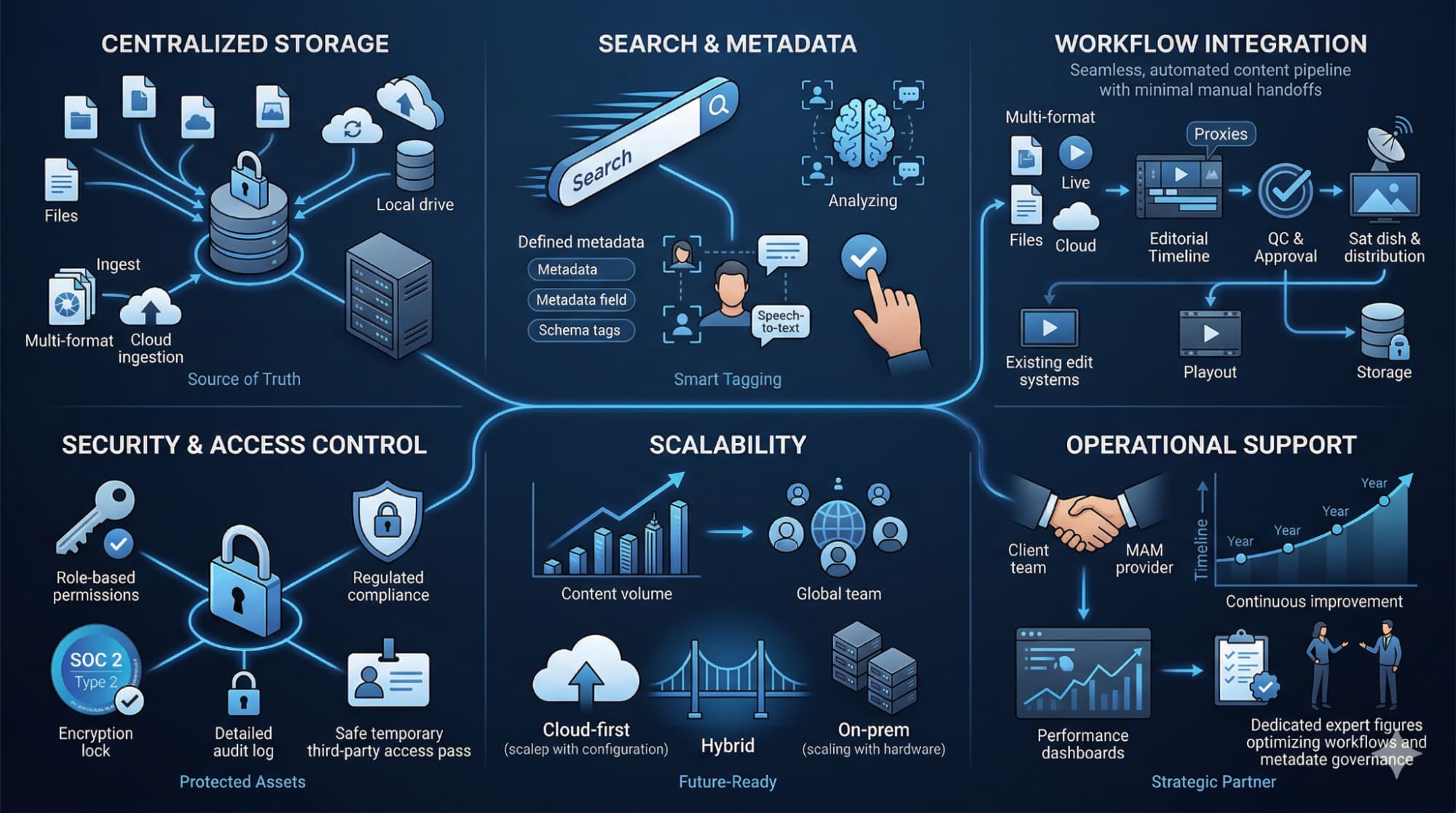
Centralized Storage and Organization
The first thing to evaluate is whether the platform centralizes your content or becomes another silo.
A real MAM implementation creates a single source of truth: one place where assets live, where they are tagged, and where teams across locations can find them.
Pay attention to ingestion as well.
- Does it integrate with the formats your team works in?
- Does it support file-based, live, and cloud ingest?
A platform that only fits your current workflow will force a migration later.
Searchability and Metadata
Search is the most important functional test for any MAM.
If your team cannot find content quickly, they won’t use the system. They will revert to shared drives, local storage, or ad hoc tools.
Effective metadata requires structure. A defined schema that reflects how your organization actually uses content, not just generic fields.
Campaign ID. Talent rights expiry. Usage restrictions. Approval status.
AI can accelerate metadata creation through transcription, object detection, and tagging. These tools make content searchable faster and at scale.
But AI does not replace metadata strategy.
It does not understand business context, usage intent, or licensing requirements. Those require human oversight and governance.
A strong MAM implementation combines both:
- automated metadata enrichment
- structured, human-defined metadata standards
Integration with Production and Distribution Workflows
A MAM system that sits outside your workflow is just a well-organized archive.
A media asset management company should demonstrate how the platform connects directly to:
- ingest
- editorial
- review and approval
- distribution
Each stage should be linked with minimal manual handoffs and clear visibility into asset status.
Strong integrations are not just connectors. They define how content moves.
Ingest should trigger proxy creation, metadata enrichment, and routing to editorial. Post-production should feed directly into QC, approvals, and distribution.
If teams are still manually moving files between systems, the workflow is incomplete.
Scalability
Where you are today is not where you will be in two years.
The system needs to scale with:
- content volume
- team size
- geographic distribution
Cloud and on-premise decisions should be based on workflow and business needs, not preference.
Evaluate how costs scale over time as well. Storage may appear inexpensive, but transfer and retrieval patterns can significantly impact total cost.
Security and Access Control
Role-based permissions are non-negotiable.
The right people need access to the right content, and restricted assets must remain protected.
For regulated industries, look for:
- SOC 2 Type 2 compliance
- encryption at rest and in transit
- audit trails
Also evaluate how the system handles external users such as freelancers and partners. Access should be controlled without slowing down collaboration.
Cloud vs. On-Premise Flexibility
The right deployment model depends on your operation.
Broadcast environments handling high-resolution content may require on-premise performance. Distributed teams benefit from cloud accessibility.
Many operations require a hybrid model.
Be cautious of vendors who push a single approach regardless of your workflow. The right solution should adapt to your needs.
Ongoing Support and Operations
This is where the difference between a software vendor and a true media asset management company becomes clear.
Deploying a MAM platform is not the finish line. It’s the start of an operational lifecycle.
Metadata evolves. Workflows change. New formats and distribution channels emerge.
Without ongoing oversight, even well-designed systems degrade.
A strong partner provides:
- continuous workflow optimization
- metadata governance
- operational support aligned with production
This is what turns a MAM system into a long-term operational asset
Take the Media Asset Management assessment to determine if your current system needs an upgrade.
MAM as Part of a Larger Media Ecosystem
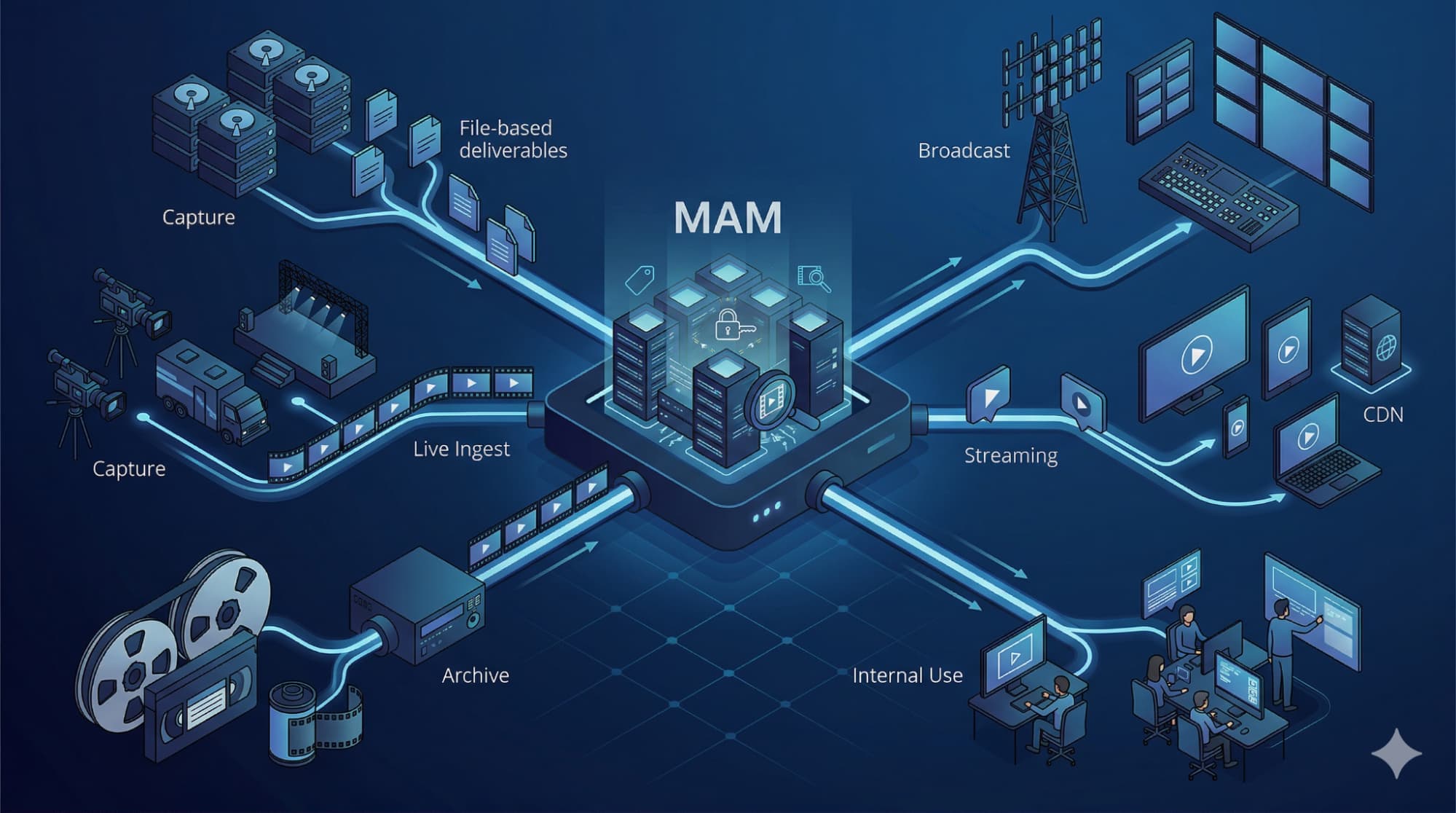
Media asset management doesn’t operate on its own. It connects directly to every stage of your content operation.
On the front end, it ties into how content is captured and ingested, whether that’s file-based deliverables, live event feeds, or archived material. On the back end, it connects to playout systems, distribution platforms, and internal portals.
That connectivity is what separates a working system from an expensive shared drive.
If MAM sits off to the side, teams will work around it. If it sits at the center of the workflow, it becomes something the entire operation depends on.
Organizations building out live production, managed services, or broadcast infrastructure should think about MAM as part of the system from the start, not as something to layer in later.
When it’s integrated properly, everything moves faster, and the return on the system becomes much more visible.
How to Choose the Right Partner

Start with your workflow.
If you can’t clearly map how content moves from ingest to archive, it’s going to be difficult to evaluate any platform effectively. The first step is understanding where things slow down, where handoffs break, and where visibility is missing.
From there, look at scale.
Be honest about where your operation is today and where it’s going. A system that works for a smaller content library won’t hold up as volume, teams, and distribution needs grow.
It’s also important to look beyond the platform itself.
A MAM system is only as effective as the team implementing and supporting it. That includes how workflows are designed, how metadata is structured, and how the system is maintained over time.
Ask for real examples at your scale. A company that has supported operations similar to yours will be far more valuable than one that only demonstrates features in isolation.
The Right Partner Changes the Outcome
Content production isn’t slowing down.
As volume and complexity increase, media asset management becomes a core part of how organizations operate, not just a supporting system.
The difference isn’t just the technology. It’s the company behind it.
A strong partner doesn’t just deploy a platform. They help design workflows, enforce structure, and make sure the system continues to work as the operation evolves.
That’s what turns MAM from a tool into something that actually improves how teams work day to day.
If you’re evaluating your options, start with your workflow and build from there. The right foundation makes everything that follows easier.
Visit our Media Asset Management Services page to learn more about BMG as your dedicated MAM service provider.
You can also take the Media Asset Management assessment to check if your current system needs an upgrade.

Mohammad Ataya is the Director of Media Asset Management Services. He specializes in data asset management, metadata governance, localization workflows, and automation, leading cross-functional teams across MENA, Asia, Europe, and North America. He helps organizations streamline high-volume, multilingual content operations through scalable systems, cloud-based distribution, and regionally aligned delivery strategies.
About Mohammad Ataya
Leave a Reply