

The broadcast industry still describes REMI services as a “budget alternative.” That framing misses the point.
If you evaluate REMI as a line-item cut, less travel, fewer per diems, and less shipping, you ignore the real payoff. REMI doesn’t help you do less. REMI helps you run smarter.
In today’s volatile production environment, the advantage isn’t just smaller onsite crews. The advantage is operational elasticity.
The Elasticity Advantage
A well-designed REMI architecture provides a centralized Production Control Room (PCR) that serves multiple venues and shows. You don’t just “move people offsite.” You build a distributed technical team that works from optimized hubs using infrastructure that scales with demand.
Compare that to the traditional mobile unit model:
- A truck has fixed costs and fixed capacity.
- It also has downtime by design: transit, load-in, load-out, and travel days.
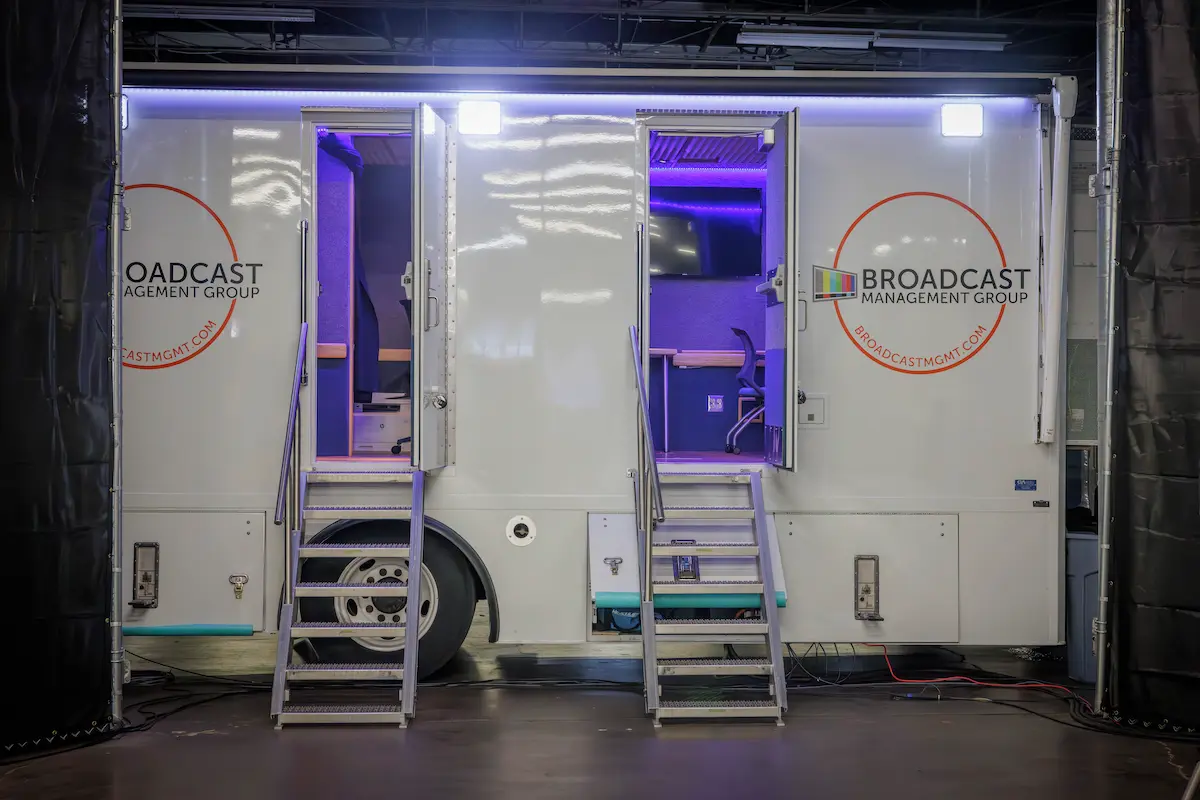
- A 53-foot truck driving from Chicago to Kansas City produces zero content while it moves. That time becomes sunk cost.
A centralized PCR behaves more like a cloud resource. It can run a corporate town hall in the morning, a sports broadcast in the afternoon, and a pre-taped segment at night—without booking flights, rolling cases, or burning days on the road.
That elasticity unlocks faster deployment of:
- Pop-up productions that used to be cost-prohibitive, letting rights holders monetize niche events.
- Shoulder programming (pre-game/post-game) is produced remotely to extend rights value without expanding onsite footprint.
- Secondary feeds that drive digital engagement—alternate casts, coach’s cam, data-rich streams for OTT.
The market signal is clear. With REMI projected to grow at an annual rate of 39% by 2033, broadcasters have moved past “emergency remote.” They now build standardized, scalable ecosystems.
REMI Is a Systems Design Problem, Not a Shopping List
The strongest REMI deployments treat the work as systems design, not procurement.
Sending an encoder to a venue doesn’t create a workflow. You have to design for the ugly moments, the edge cases that kill shows:
- What happens when your primary circuit jitters mid-game?
- How does the director talk to a handheld op when the return path degrades?
- How do you manage mix-minus when talent sits in three cities with different latency profiles?
REMI succeeds when engineering, production leadership, and operations align around workflow, not geography.
When you do that, you unlock:
- Higher asset utilization: Control rooms and core gear stop sitting idle on highways. They produce billable hours, turning Capital Expenditures into a revenue engine.
- Better crew specialization: Your top directors, graphics ops, and replay ops work premium shows without constant travel. You protect talent and reduce burnout.
- Expanded coverage: You cover more events without matching cost growth—critical for conferences and leagues with high volume and lower rights fees.
- Sustainable margins: Fixed infrastructure begins to behave like scalable operating capacity. As the event count rises, the margin per event improves.
You also need a cultural reset. REMI fails when teams operate like “onsite vs. remote.” REMI wins when you run a single hybrid unit connected by low-latency fiber and unified comms.
Hybrid Intelligence Is the Next Step
Stop treating this as REMI vs. onsite. Run hybrid intelligence instead: assign the right roles to the right places for the right tier of production.
You still need a major on-site footprint for a Super Bowl-scale event. The complexity, immediacy, and sheer logistics demand boots on the ground.
But for a Tier 2 college sports production, a recurring corporate executive briefing, or a routine studio hit, a heavy onsite presence becomes operational bloat.
The strategy is simple: audit your slate and assign the correct model per show tier. Standardize the repeatable pieces. Escalate onsite only when the content truly requires it.
Remote production is no longer experimental. It’s infrastructure. SMPTE ST 2110 and 5G matured. Connectivity usually isn’t the bottleneck anymore. Workflow design is. The industry engineered down the worst latency problems with better encoding, smarter routing, and dedicated paths. Now execution depends on architecture, comms, redundancy, and operational discipline.
Build for 2026, Not 2019
If you still treat centralized production as a temporary efficiency play, you build for 2019.
To build for 2026 and beyond, treat REMI as a core operating model because the real win isn’t cheaper shows.


Leave a Reply