Industry context: “Remote production is the cornerstone of the Milan Cortina venue coverage,” said Darryl Jefferson, SVP of Engineering & Technology at NBC Sports & Olympics. That single sentence is a blueprint, not a tagline.
Running 16+ days of simultaneous live sports across dozens of venues, multiple platforms, and international distribution isn’t just a “bigger show.” It’s a different operating model. Whether you’re supporting a rights holder, a league, or a brand, the same principles apply to any sports video production service trying to scale output without scaling risk.
Yes, the technology stack gets headlines. All‑IP cloud workflows, 100+ cameras, distributed production between Italy and U.S. hubs, real-time graphics tied to official timing data. But the hardware isn’t the lesson.
The lesson is that infrastructure has to be built around repeatable systems, clear governance, and operational discipline that scale without breaking.
Below are nine rules that apply to Olympic-scale operations and to large-scale video production.
The 9 rules that scale live ops without scaling chaos
1) Codify the work before you multiply it
At the Olympic scale, you don’t wing it show to show. You write the playbook before you scale it. You standardize first, then scale. Every additional event, feed, or production day should behave predictably because the playbook already accounts for it.
In practice: One runbook per show type, a pre-flight checklist, and defined “go/no-go” criteria for every feed before you take it live.
2) Put systems before growth
Scaling is a shift from heroics to structure. Without repeatable systems, complexity expands faster than output.
In practice: Standardized naming conventions, consistent routing logic, consistent audio layouts, consistent comms structure—so new shows don’t require reinvention.
3) Build a “central nervous system,” not islands of automation
Point solutions create fragmented workflows. Large-scale video productions fail when each venue or team runs a disconnected stack. The fix is a coordinating layer, orchestration + centralized signal management, that understands dependencies and transitions across the entire flow.
In practice: Centralized routing/orchestration with documented handoffs (venue → contribution → control room → distribution) and a single source of truth for what’s on-air.
4) Make reliability a measured target (not a hope)
Olympic-grade expectations sit near “five nines”—99.999% uptime thinking. That mindset drives redundancy design, test plans, and live incident response.
In practice: Dual contribution paths, tested failover, defined RTO/RPO targets, and scheduled drills (not “we think it’ll work”).
5) Build for visibility first
One of the most common failure modes at scale isn’t a technology failure; it’s a visibility failure. Teams can’t see what’s happening across systems and locations in real time, so response becomes slower and more chaotic.
In practice: Real-time dashboards for feed health, audio presence, captions/SCTE status, and last-mile delivery paired with alert thresholds tied to roles.
6) Clarify governance and decision rights before the event
Scaling breaks when ownership is fuzzy. Clear “who decides what” reduces second-guessing during incidents and handoffs.
In practice: A responsibility map that answers: Who owns venue acquisition? Who owns the contribution? Who owns playout? Who declares an incident? Who approves fallback formats?
7) Run incidents with a simple command structure
When something breaks live, you need structure: one incident lead, one comms channel, one escalation path. Otherwise, you get parallel troubleshooting, conflicting changes, and avoidable downtime.
In practice: An incident playbook that includes severity levels, response time targets, and “stop-the-bleeding” fallback actions.
8) Scale the workforce model, not just headcount
Stacking more bodies on an unclear workflow doesn’t scale; it multiplies confusion. Olympic-scale operations work because roles are designed for distribution: what must be onsite stays onsite; everything else centralizes.
“This is exactly why a modern Remi production service depends as much on transport, orchestration, and monitoring as it does on the control room.”
In practice: Fewer duplicated roles at each venue, more centralized specialists supporting multiple venues, and tight coordination between field acquisition and central production.
9) Double down on what already works
Scaling is doing more of the proven patterns, not reinventing them under pressure. The biggest shows succeed by repeating what’s already reliable and resisting last-minute experimentation.
In practice: Lock standards early (formats, routing, naming, monitoring), and keep show-day changes to a controlled minimum.
The technology that enables the operating model (and why it matters)
The right infrastructure doesn’t automatically create scale, but it makes scale possible when paired with the rules above.
| Capability | What was used (publicly reported online) | Why it matters in live production and footprint |
|---|---|---|
| All‑IP distributed production | IP workflow spanning Italy + U.S. hubs | Enables REMI-style ops; shifts more roles to central facilities |
| Cameras + centralized shading | 100+ Sony system cameras; remote shading/control via IP | Consistent look; fewer onsite shading positions per venue |
| UHD/HDR lensing | Canon UHD broadcast lenses | Optical performance for demanding venues and HDR |
| Graphics + official data | Chyron graphics + SMT timing/scoring | Real-time sync between official results and on-screen data |
| AR analysis | Ross Voyager + Rocket Surgery support | More immersive storytelling; less dependence on physical explanations/props |
| LED video walls | Planar LED walls | Rapid scenic changes without rebuilding sets |
| IP networking | Cisco IP fabric + WAN tooling | Predictable transport; better failure analysis and capacity planning |
| Signal routing/orchestration | Grass Valley tools (conversion + routing + orchestration) | Repeatable routing across formats, sites, and teams |
| Contribution encoding/transport | Appear contribution (fiber + satellite + cloud transport referenced) | Efficient bandwidth; more feeds back to central production reliably |
| Audio + comms monitoring | Audio-Technica mics/headsets/monitoring | Standardized audio capture and comms monitoring across sites |
| Multiscreen publishing | Comcast Sports360 / Cloud Video Platform | Faster highlights/replays publishing with metadata |
Bottom line: these choices align with the same principles: centralize what can be centralized, standardize what will repeat, and build for observability before you build for “more.”
How BMG applies this at the Washington Broadcast Center expansion
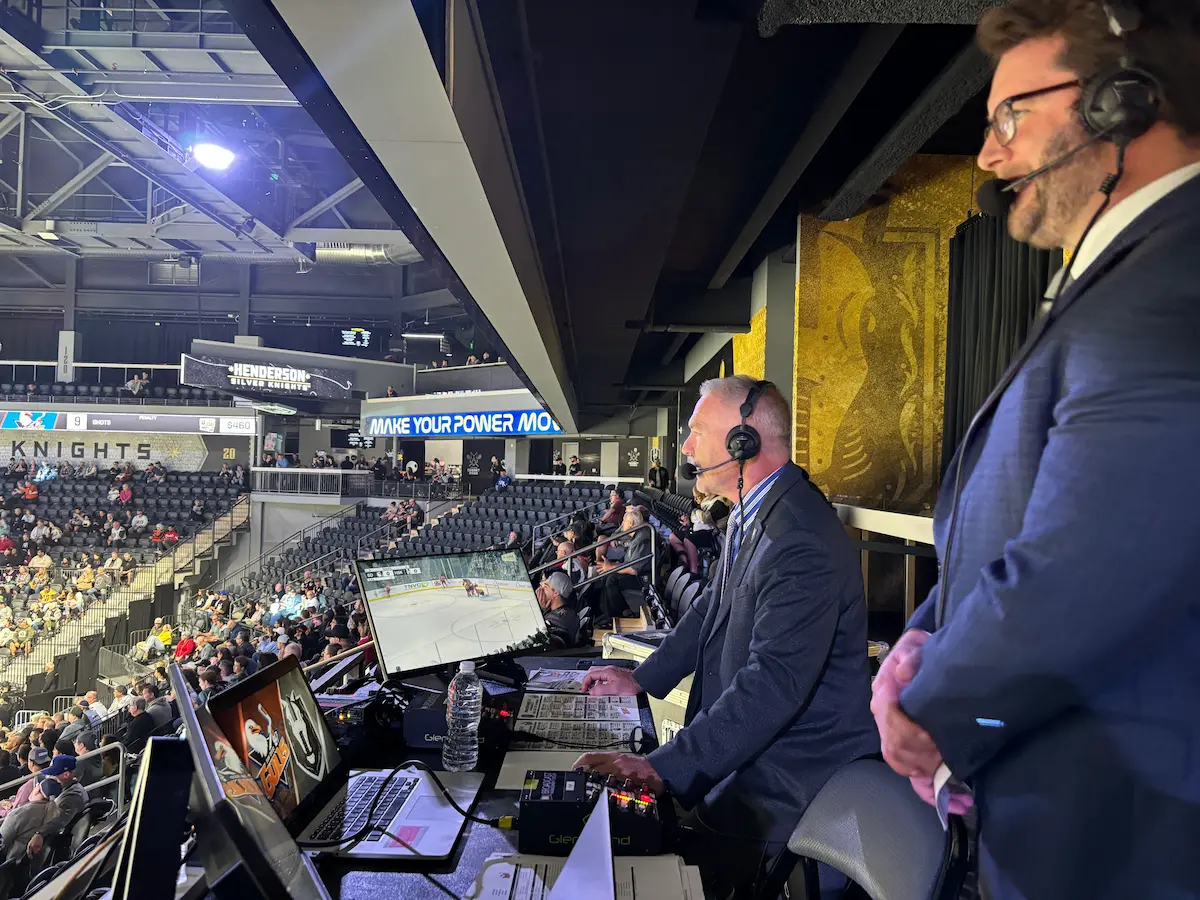
The Broadcast Management Group Washington Broadcast Center expansion is designed around the same “systems scale” model so complex shows can be executed consistently, not heroically.
- Centralized control + standardized execution: our expanded operations are built to support repeatable runbooks, consistent comms plans, and predictable handoffs across shows.
- Studios built for fast-turn, high-stakes programming: With 3 studios, a podcast room, and a 16-person newsroom, the Washington Broadcast Center expansion is designed for repeatable Multi-camera production with consistent comms, runbooks, and real-time visibility across shows.
- One integrated ecosystem (not vendor islands): we bring production, distribution, and managed services together so signals, people, and processes stay coordinated across the full chain.
- Visibility-first operations: we design workflows so teams can see issues early, respond quickly, and keep decisions organized under pressure, especially in multi-show, multi-platform scenarios.
- Designed for scalable staffing models: the facility supports centralized roles that can scale across multiple productions, while keeping onsite work focused where it truly adds value.
The takeaway
Olympic-scale broadcasts are the clearest proof point in live video: systems scale, heroics don’t. If you’re building or scaling large-scale video production for sports, enterprise, or media the blueprint is consistent:
Codify first. Centralize what you can. Instrument visibility. Define governance. Practice failure. Repeat what works. This is what we do at Broadcast Management Group to handle large-scale live video production.
CTA: Book a consult
If you’re planning a new video studio build, a remote video production model, or managed services for complex live operations, we’ll help you map the workflow, identify failure points, and design a scaling plan.
Sources: publicly available reporting. No affiliation with rights holders.