

Election Season Broadcast Readiness
Broadcast-grade election programming for domestic and international broadcasters—designed for consistency, scalability, and reliability under intense scrutiny. Supported by BMG’s 24/7 Cloud Network Operations Center (NOC).
To ContentIf you’re reading this now, you’re already ahead of most of the market.
The organizations that successfully air election town halls, Q&A’s, rallies, interviews, debates, and other key events are the ones who lock in their crew, equipment, and production plan weeks before air, not the ones still finalizing it the week of.
Below is the checklist we walk through with any organization producing election coverage.
The Checklist
1. Crew & Equipment
- EIC, technical director, and full camera crew locked
- Audio (A1/A2), and graphics/replay operators confirmed
- Primary and backup connectivity secured (IP, satellite, bonded cellular)
- Backup crew identified in case of a last-minute drop
Why it matters: a fully staffed, creative, and technically sound crew is the foundation upon which everything else on this list depends. No redundancy plan fixes a missing camera operator.
Common roadblock: every network covering election events needs the same pool of qualified EICs, TDs, and RF engineers on that night. Crews and gear get committed to whoever asks first, and once they’re booked, they’re gone regardless of budget.
Benefit: a crew that’s worked together before catches problems earlier and moves faster than one assembled ad hoc. It shows up in how smooth the broadcast feels, not just whether it airs.
2. Redundancy
- Backup transmission path in place
- Backup power on-site or contracted
- Failover control room
- Redundancy plan tested in advance, not assumed
Why it matters: The event can’t be rescheduled if something breaks.
Common roadblock: redundancy is the first line item cut under budget pressure until it’s the specific night everything depends on it being there.
Benefit: the broadcast stays on air despite a hardware failure or dropped signal, and the audience never knows anything went wrong.
3. Multi-Location Coverage — Several States, Mobile Units & Flight Packs
- Centralized (REMI) workflow for multi-state coverage
- Mobile unit or flight pack assigned to each venue, connected back to a centralized NOC, not operating as a standalone truck
- Truck access confirmed at every location — flight pack ready where it isn’t
- Field-to-edit pipeline mapped for content moving between cities
Why it matters: For election results specifically, they come in market by market, not all at once. Coverage that can’t move fluidly between locations falls behind the story as it develops.
Common roadblock: covering multiple states usually means multiple disconnected teams — until something goes wrong in one market and nobody at HQ knows until it’s too late.
Benefit: coverage that feels like one coherent network broadcast, even when it’s happening across five states at once.
We’ll review your plan and show you every point of failure in it.
Book the Assessment
4. Creative — Producing, Directing, Graphics, Set & Lighting, Post-Production
- Show format and run of show finalized
- Real-time results/graphics package built and tested
- Set and lighting design confirmed
- Post-air clips and highlight plan in place
Why it matters: viewers judge credibility by what they see on screen — a broadcast that looks assembled at the last minute reads that way, regardless of how solid the technical plan is underneath it.
Common roadblock: creative is treated as the last step before air instead of part of the technical plan, which means graphics, set, and lighting decisions are made under pressure rather than tested in advance.
Benefit: a broadcast that looks and feels like a network production, which is what keeps viewers watching through a long night instead of switching over.
5. 24/7 NOC & REMI Workflow
- One team with visibility across every location — not separate islands
- Remote correspondent integration tested before air
- Monitoring coverage confirmed for the full broadcast window
- Mobile units on-site linked live to the NOC, not producing in isolation
Why it matters: with coverage spread across multiple locations, someone has to be watching all of it at once. A single studio director can’t monitor five markets and produce the show at the same time.
Common roadblock: without centralized monitoring, a technical issue in one market doesn’t surface until it’s already affected the broadcast, because no one has visibility into that feed.
Benefit: problems get caught and corrected before they’re ever visible on air.
We’ll review your plan and show you every point of failure in it.
Book the Assessment
6. Master Control, Transmission, Channel Playout
- Master control staffed or augmented for the night
- Transmission redundancy confirmed across satellite, fiber, and cellular
- Playout plan set for what airs after the broadcast ends
Why it matters: this is the layer that actually gets the broadcast to air and keeps it there. Everything else on this checklist is preparation for what happens here.
Common roadblock: transmission paths that handle a normal broadcast can get overwhelmed when there are more than the typical number of destinations required for election coverage.
Benefit: an uninterrupted signal to sign-off, with a clean handoff into whatever airs next.
7. Studio Option — Studio Needs
- Determined whether this calls for full deployment or a lean studio model
- Backup studio access
Why it matters: not every production need a full mobile deployment; a lean, high-output studio can cover it without the cost or footprint of a full truck-and-crew build.
Common roadblock: organizations default to a full deployment because it’s the only model they know, and pay for scale they don’t actually need.
Benefit: full production value at a fraction of the cost and crew of a full deployment.
8. Mobile Studio — Washington, DC Metro Area
- Backup venue identified if your first choice falls through
- Metro-area mobile studio option confirmed as a fallback
Why it matters: the venue you want may already be booked. A DC-area mobile studio means that it’s a scheduling problem, not a dead end.
Common roadblock: by the time a primary venue falls through, there’s no time left to build a backup plan from scratch; the fallback has to already exist.
Benefit: a guaranteed path to air even if the venue you wanted isn’t available.

The Proof Behind This Checklist
Crew & equipment, on short notice
Awarded PBS’s America After Charleston two weeks before the shoot date and built a full crew and technical plan from nothing in that window. Coordinated 255+ crew across four cities in three weeks for Al Jazeera’s election town hall tour.
Redundancy, built in from the first site survey
Ran an HD production truck and a separate satellite transmission truck, plus backup power, into a venue with zero infrastructure for ARTE France. Built full lighting and power into an 1892 church with none for PBS.
Creative that’s designed in, not bolted on
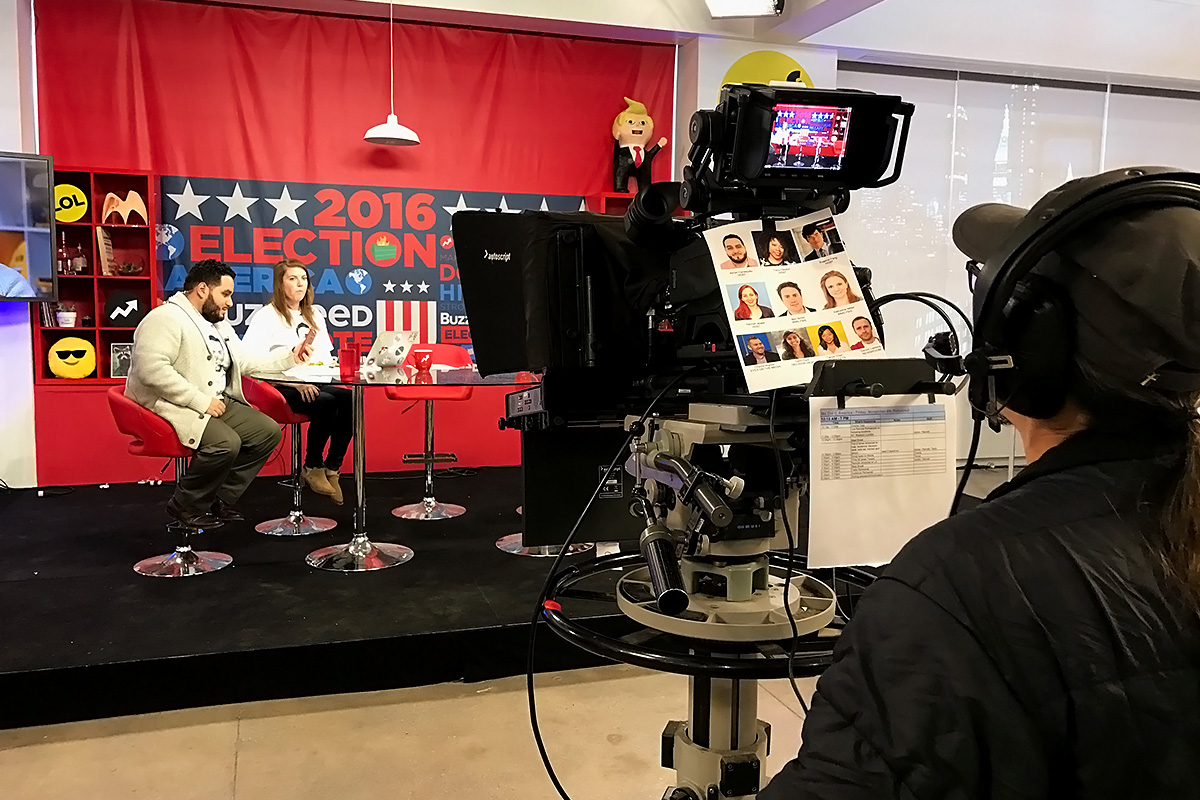
Designed and rebuilt a custom traveling set across four venues for Al Jazeera. Built a full graphics system from scratch for BuzzFeed’s first-ever live broadcast.
Multi-location coverage that doesn’t fragment
Ran simultaneous coverage across three cities, Cleveland, Philadelphia, and DC for BET, with field content routed to a centralized edit team. When BuzzFeed’s venue couldn’t physically accommodate a mobile unit, we deployed a flight pack across two conference rooms instead. For the U.S. State Department, we stood up seven live remote studios across seven countries: England, Japan, Lebanon, Colombia, Nigeria, India, and Australia, anchored at the Newseum in DC, fully booked, staffed, and transmission-tested in six days.
A mobile studio when the obvious venue isn’t available
Every iconic DC venue was booked for ARTE France’s 2008 election special. We produced from a rooftop in Arlington instead — the same situation this checklist exists to help you avoid.
There are not many folks who would think it possible to produce such an incredible program in such a short amount of time. But I am so proud of what you were able to produce.
James Blue — Director of Current Affairs and Special Programs, BET
Book an Election Coverage Readiness Assessment
We’ll review your plan and show you every point of failure.
Gravity Forms Privacy Policy and Terms of Service apply.
"*" indicates required fields