At this year’s SMPTE Bits by the Bay, Tawfiq Rahman, BMG’s Vice President of System Design & Engineering, presented “Built to Evolve: Navigating the Shift to Software-Defined, AI-Augmented Broadcast.”
The presentation looked at where broadcast infrastructure has been over the last 20 years, and where it is likely headed over the next decade: IP, cloud, orchestration, AI-supported operations, and more flexible system design.
A major theme of the presentation was that broadcast engineering does not need to dismiss the systems that got the industry here.
SDI worked for a reason. It gave engineers predictable timing, reliable switching, straightforward redundancy, and physical troubleshooting tools that made sense under pressure. For live production, that mattered. A lot.
The issue is that facilities are now being asked to do more than SDI-based architectures were originally designed to support. One environment may need to handle more channels, more formats, more remote contribution, and more distribution endpoints than ever before.
Linear, OTT, FAST, social, cloud, and remote production are increasingly part of the same conversation. That changes how systems need to be planned.
SDI Wasn’t Wrong. The Era Changed.
One of Tawfiq’s key points was that SDI shouldn’t be treated like outdated technology that failed.
It lasted because it was effective.
For decades, SDI gave broadcast engineers a system they could trust. Timing was deterministic. Switching was frame-accurate. Signal paths could be patched, tested, and understood in a physical way. Redundancy was relatively easy to reason through when something went wrong.
The issue is that today’s requirements are different.
That is why SDI remained the standard for so long.
But the demands around broadcast have changed. Modern production environments need to support UHD, HDR, multi-language audio, remote contribution, distributed teams, and multiple delivery formats. As those requirements multiply, fixed point-to-point systems become harder to scale and harder to adapt.
The takeaway is simple: new facilities need to be designed around the requirements they are facing now, not the requirements of the last generation.
IP and NMOS Are Becoming the New Foundation
A major focus of the presentation was the role of ST 2110 and NMOS in modern broadcast system design.
Tawfiq framed ST 2110 as more than “video over IP.” It separates video, audio, and metadata into independently routable essence streams, synchronized through PTP timing and transported over standard Ethernet infrastructure.
But transport alone is not enough.
That is where NMOS becomes critical. NMOS allows devices, sources, senders, receivers, and flows to be discovered, registered, and connected through a control layer.
Without NMOS, an IP plant can quickly become difficult to operate at scale. With it, IP starts to behave like a manageable broadcast system.
For new builds, Tawfiq’s view is clear: IP and NMOS are becoming the foundation. Brownfield facilities may trail behind, but the direction is set.
AI Belongs in Operations
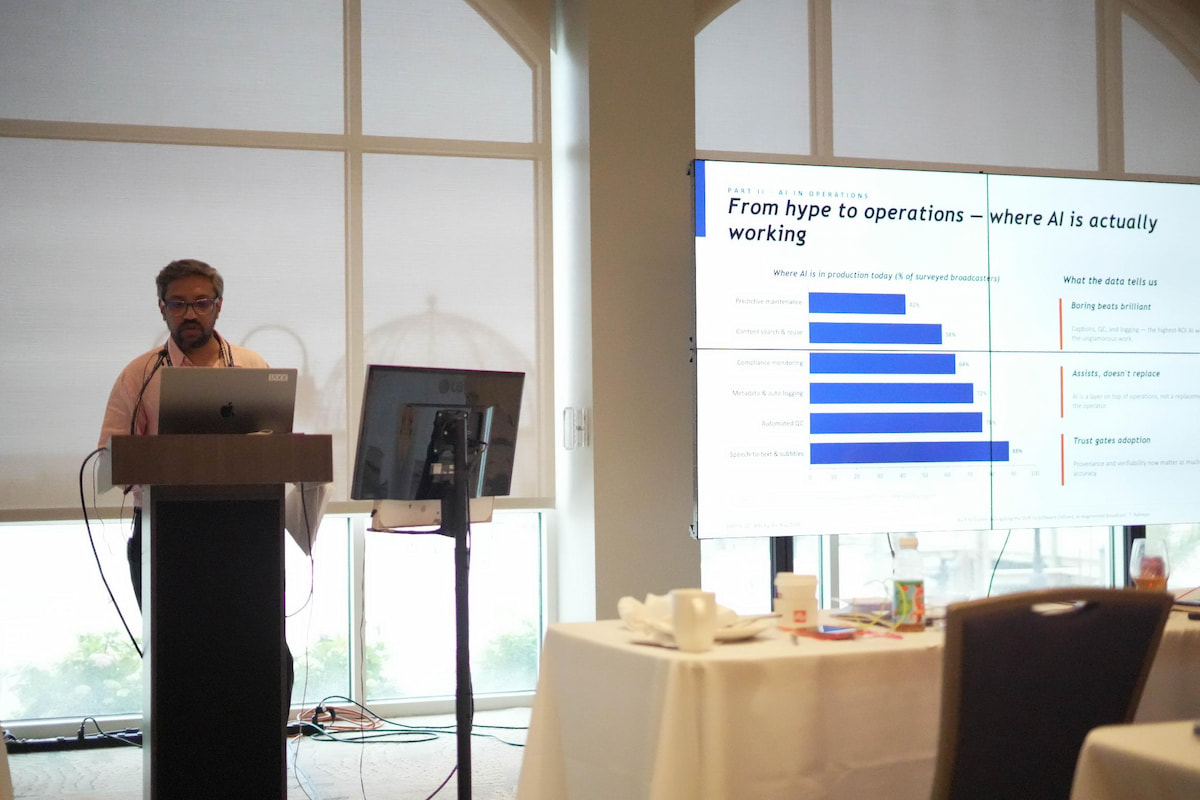
Tawfiq’s AI point was grounded in practical use cases.
The strongest use cases today are showing up in the operational parts of the workflow, where teams spend a lot of time doing repetitive, detail-heavy work.
That includes:
- Speech-to-text and captions
- Automated QC
- Metadata generation
- Compliance monitoring
- Content search and reuse
- Predictive maintenance
These are not the flashiest AI use cases, but they are the ones that can make an immediate difference. Captions, QC, metadata, and search all take time. They all affect how quickly content can move through an operation. They all create friction when they are handled manually at scale.
For broadcast teams, the opportunity is to use AI where the workflow already has pressure. Not because it sounds futuristic, but because it can reduce manual effort and help teams manage larger media operations more efficiently.
Trust Has to Be Engineered
As AI becomes part of media operations, trust becomes a technical requirement.
Tawfiq highlighted provenance, watermarking, chain of custody, and verification as critical parts of future broadcast infrastructure. In an environment where manipulated media is easier to create, organizations need systems that can verify where content came from, how it changed, and whether it can be trusted.
This is especially important for organizations producing news, live events, corporate communications, public affairs content, and high-visibility programming. Once content moves through multiple tools, platforms, and distribution paths, the ability to verify it becomes part of the infrastructure.
Authenticity cannot sit outside the workflow. It has to be built into it.
The Team Is the Leading Variable
Technology was only part of Tawfiq’s message.
The engineering skill set is changing just as much as the infrastructure.
Video and audio fundamentals still matter. Color, levels, loudness, sync, latency, and frame timing are still core to live production. Those skills do not go away because the facility becomes more IP-based.
But they now sit alongside networking, cybersecurity, orchestration, APIs, observability, and AI literacy.
That is a real shift for engineering teams. The best facilities will not be built by people who only understand broadcast or only understand IT. They’ll be built by teams that can move between both worlds.
The answer isn’t to replace broadcast engineers. It’s to help them expand. The people who understand live production already know what is at stake when something goes wrong. The next step is giving those teams the tools and training to operate in more software-defined environments.
How This Connects to BMG’s Work
Tawfiq noted that BMG’s own infrastructure served as a practical case study for many of these ideas.
BMG’s Network Operations Center, Cloud Control Center™, REMI workflows, managed services, and systems integration practice are all built around the same principle: broadcast systems need to be designed for flexibility, scale, and long-term evolution.
That means building environments where production, playout, media asset management, master control, transmission, monitoring, and engineering can work as one connected operation.
It also means designing systems that can support today’s requirements while staying adaptable for what comes next.
The Bigger Takeaway
The next phase of broadcast will be shaped by how well these pieces work together.
- IP gives facilities more flexibility.
- Cloud makes production and compute easier to scale.
- AI can reduce friction in operational workflows.
- Standards and provenance help keep systems interoperable and trusted.
- Skilled engineers are what make all of it usable under live conditions.
That was the most useful part of Tawfiq’s message. The industry does not need to chase every new technology trend at once. It needs to design systems that can evolve without breaking the operation they support.
For organizations planning new studios, control rooms, production facilities, or managed broadcast operations, that may be the most important takeaway of all.

Paige DeLoretta is a marketing professional with experience in social media and digital marketing, creating engaging content that helps brands grow and connect with audiences. She has supported marketing initiatives across a variety of industries. Paige is a graduate of George Mason University with a degree in marketing. Originally from Reading, Pennsylvania, she enjoys traveling, spending time outdoors, and exploring Washington, D.C. with friends and family.
About Paige DeLoretta