

A studio-quality show does not always need a permanent physical set.
For organizations producing recurring programming, executive communications, financial updates, sports shows, interviews, product launches, entertainment content, or branded series, the traditional studio model can become limiting. Physical sets take space, time, money, and labor to build. They’re harder to change when branding evolves, formats shift, or talent is working from different locations.
Virtual set design gives production teams another option.
A well-built virtual studio can create a polished, repeatable production environment without requiring every show to be tied to one physical space. The set can change. The branding can update. The layout can evolve. Talent can be integrated into environments designed for the show, the audience, and the distribution platform.
But virtual sets only work when they are built for production.
They aren’t just backgrounds or creative concepts. They’re broadcast environments that need to be designed, engineered, tested, and operated like any other live production system.
Virtual Sets Solve a Real Production Problem
The value of virtual set design is not simply that it looks modern.
The real value is flexibility.
Organizations often need to produce more content than their physical spaces can support. One team may need an executive update in the morning, a panel discussion in the afternoon, a product demo the next day, and a recurring interview series every week. Each format may need a different look, different branding, different graphics, and different production needs.
A physical set can make that difficult.
Changing scenic elements takes time. Rebuilding a studio for every format is expensive. Brand updates can require new fabrication. Multiple shows may compete for the same space. Talent may not always be in the same city.
Virtual studios help solve that by separating the creative environment from the physical footprint.
Instead of rebuilding the room, the production team can change the environment. A virtual set can support different formats, looks, layouts, and graphics packages while still operating through a consistent production workflow.
That makes virtual set design especially valuable for organizations producing repeatable programming.

This Is Not a Virtual Background
There’s a major difference between a virtual set and a virtual background.
A virtual background can make a video call look more branded. A virtual studio is designed to support a live or recorded production.
That distinction matters.
Most weak virtual productions fail because design is treated separately from engineering. The environment may look good as a still image, but it doesn’t hold up once talent, lighting, camera movement, graphics, audio, and switching are introduced.
Common problems include:
- Talent that appears to float inside the environment
- Lighting that does not match the virtual space
- Camera angles that feel unnatural
- Graphics that do not integrate cleanly
- Tracking that is unreliable
- Delays between physical movement and virtual response
- Sets that only work for one format
- Workflows that cannot be repeated consistently
A real virtual studio has to be engineered as a production system.
That means the creative design, camera tracking, lighting, graphics, switching, audio, monitoring, and transmission workflow need to be planned together from the beginning.
Why Remote Production Changes the Set Design Conversation
Remote production (REMI) makes virtual set design even more valuable.
In a traditional studio model, the production environment, control room, crew, and talent are often built around the same physical location. In a remote production or REMI workflow, those pieces may be distributed.
Talent may be in one studio. The director may be in another city. Graphics may be operated remotely. Switching may happen from a centralized control room. Engineering and monitoring may be supported through a Network Operations Center. Content may be delivered to multiple platforms.
That means the virtual set cannot be designed only for how it looks on camera. It also has to support how the production will actually run.
A remote production virtual set needs to account for:
- How talent is captured
- How cameras are framed and tracked
- How lighting supports the virtual environment
- How graphics and data appear inside the set
- How remote operators access production tools
- How the director monitors the show
- How audio, switching, and playback are handled
- How the final feed is encoded, transmitted, recorded, and archived
The set is one part of a larger production ecosystem.
When that ecosystem is designed correctly, a virtual studio can give organizations the look of a professional set with the flexibility of a remote production workflow.
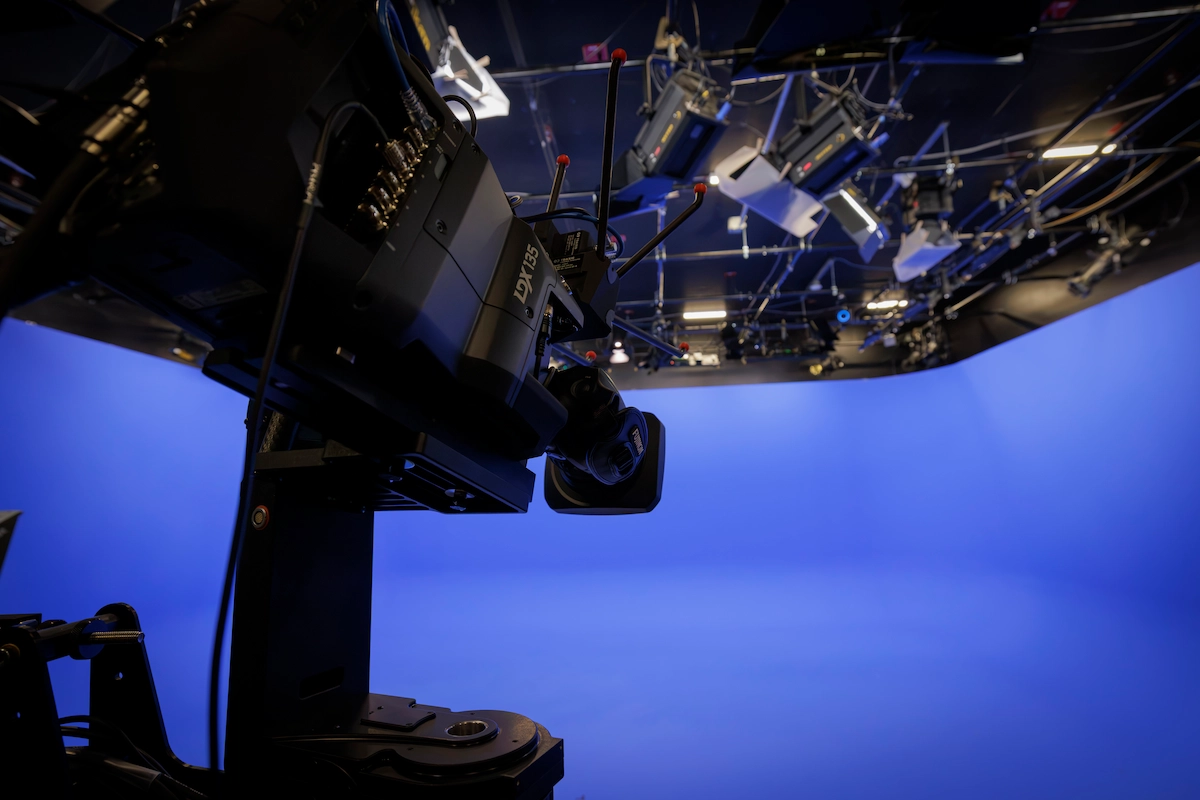
How a Virtual Studio Workflow Comes Together
A strong virtual studio workflow connects creative and technical systems into one repeatable production model.
Physical Capture
The physical capture environment is where talent, cameras, lighting, audio, and staging come together.
This may be a green screen studio, a smaller physical studio, a corporate space, or another controlled capture environment. The goal is to make sure talent is captured cleanly and consistently so they can be integrated into the virtual set.
Lighting is especially important. Talent needs to feel like they belong in the environment, not like they were placed on top of it.
Real-Time Virtual Engine
The virtual engine powers the environment.
This is where the set, camera tracking, depth, perspective, and movement come together in real time. For live production, the system needs to respond reliably under show conditions.
The virtual world cannot lag behind the physical production.
Integrated Graphics and Data
One of the biggest advantages of virtual set design is the ability to integrate graphics, data, playback, and branded elements directly into the environment.
That may include lower thirds, charts, sponsor elements, financial data, show branding, social content, video playback, or live information feeds.
For recurring programming, this gives teams a more flexible way to update content without rebuilding the set.
Centralized Production
In a remote production model, the core production workflow can be centralized.
Switching, graphics, audio, playback, monitoring, transmission, and production support may be handled from a control room, REMI environment, or cloud-connected production facility.
This allows organizations to produce studio-quality content while giving the production team access to experienced operators, centralized infrastructure, and remote workflow support.
Distribution and Archive
The workflow doesn’t end when the show is switched.
The final program may need to be streamed live, delivered to internal platforms, sent to social channels, recorded, edited, archived, or repurposed for future use.
A strong virtual studio workflow should account for distribution and content management from the beginning.
Where Virtual Set Design Makes the Most Sense
Virtual sets are most effective when the production needs consistency, flexibility, and repeatability.
They are especially useful for:
Executive and Corporate Communications
Organizations can produce leadership updates, town halls, internal broadcasts, investor communications, and executive messages inside a polished branded environment without rebuilding a physical set for every program.
Financial and Market Programming
Financial media, market updates, and analyst-driven content often require a controlled production environment, data integration, graphics, and repeatable show formats.
Sports Programming
Virtual studios can support shoulder programming, analysis shows, preview shows, recap segments, interviews, and sponsor-driven content without requiring a permanent sports studio buildout.
News and Commentary
News-style formats often need fast turnarounds, repeatable layouts, changing graphics, remote guests, and reliable production structure.
Entertainment and Interview Formats
Virtual environments can help entertainment brands create distinctive looks for interviews, companion shows, fan content, and recurring digital series.
Technology and SaaS Programming
Product launches, customer updates, training content, webinars, and executive demos can benefit from branded environments that are easier to update than physical sets.

The Production Standard Still Matters
Virtual set design shouldn’t lower the production standard.
The audience still expects clean audio, strong lighting, sharp camera work, smooth transitions, readable graphics, and a reliable stream. The fact that the set is virtual does not reduce the need for broadcast discipline.
In many ways, virtual production requires more planning because creative and technical systems are so closely connected.
A strong virtual studio should be:
- Designed for the actual show format
- Built around the camera and talent workflow
- Matched with proper lighting
- Integrated with graphics and playback
- Tested under live production conditions
- Connected to switching, audio, and transmission workflows
- Supported by operators who understand live production
- Repeatable for future episodes or events
The goal here is to create a production environment that works every time the show goes live.
Where BMG Fits
BMG designs and operates virtual studios as part of a larger production workflow.
That means virtual set design isn’t treated as a standalone creative asset. It’s connected to the systems that make the production work: cameras, lighting, audio, real-time graphics, switching, remote production, transmission, monitoring, and content delivery.
We support virtual studio projects through Creative Services, Studio Production, Remote Production (REMI), Virtual Studios, Production Staffing & Operations, IP & Cloud Workflows, and 24/7 Cloud Network Operations Center support.
Our work with the National Academy of Television Arts and Sciences is one example. BMG partnered with NATAS to produce two live Daytime Emmy Awards programs using custom virtual studio environments and REMI workflows.
That kind of production requires more than a good-looking set. It requires a virtual environment that can support real talent, live timing, remote contributors, graphics, switching, and delivery under production pressure.
Studio-Quality Without a Permanent Studio
Virtual set design gives organizations a more flexible way to produce studio-quality content.
It allows teams to create branded environments, support recurring formats, update show looks quickly, integrate graphics and data, and connect production teams through remote workflows.
But the best virtual sets aren’t built like design mockups; they’re built like production systems.
When creative design, broadcast engineering, REMI workflows, graphics, lighting, audio, and monitoring are planned together, virtual studios can give organizations the flexibility of a digital environment with the reliability of a live production workflow.
For teams producing recurring content, that can be the difference between building another physical set and building a scalable production model.
Need a studio-quality production environment without building a permanent physical set?
BMG designs and operates broadcast-grade virtual studios for live and recurring programming, combining creative design, real-time graphics, camera systems, lighting, REMI workflows, and production support into one connected environment.
Talk to BMG about building a virtual studio workflow for your next show, series, or live production.

Andrew Ryback is the Executive Vice President of Production. He brings over 17 years of experience in production management across live events, entertainment, and on-location shoots. He has managed production logistics for high-profile events, including The Emmys, The Oscars, TIFF, SXSW, Comic-Con, New York Fashion Week, Sundance, and both national political conventions. At BMG, he oversees complex productions from crew and equipment coordination to budgeting, permitting, and on-site execution.
About Andrew Ryback