The operational reality: Most broadcast failures are not caused by a single piece of technology breaking. They are caused by the gaps between teams, vendors, and systems that were never desiThe operational reality: Most broadcast failures are not caused by a single piece of technology breaking. They are caused by gaps among teams, vendors, and systems that were never designed to work together within a single operational model. End-to-end broadcast management exists to close those gaps.
Executive Summary:
- End-to-end broadcast management closes the operational gaps among vendors, teams, and systems that cause most live broadcast failures, not single technology breakdowns.
- Cloud production shifts switching, playout, graphics, and monitoring into centralized, software-defined environments, replacing capex-heavy control rooms with a scalable opex model.
- REMI (Remote Integration Model) transports camera signals from venues to a centralized NOC via IP or fiber, enabling broadcast-quality output at a fraction of the per-event cost.
- Cloud and REMI converge at the NOC, creating a unified production architecture with full signal-chain visibility, redundancy, and 24/7 accountability.
- Real-world BMG deployments – ProTour Golf, IMDb at Sundance, and Blue Origin NG-3 show how distributed productions operate as a single, cohesive broadcast.
- The real decision is operational, not technological: who owns the signal chain at 2 a.m. when something goes wrong
“End-to-end broadcast management” is a phrase that gets used often and defined rarely. It shows up in RFPs, vendor pitches, and strategy decks. Everyone claims to offer it. Far fewer actually deliver it because delivering it requires operational accountability across the entire broadcast chain: from the moment a camera goes live at a venue to the moment a viewer receives a clean signal on whatever platform they are watching.
That accountability gap between what technology can enable and what an operational team can reliably execute is exactly what cloud production and REMI have changed. Not by making the chain simpler. By making it possible to manage the chain more intelligently, with centralized oversight, distributed infrastructure, and a single point of accountability, point-solution vendors have never been able to provide.
Here is what that looks like in practice for organizations like Broadcast Management Group (BMG).
What the End-to-End Broadcast Chain Looks Like
A broadcast chain is a sequence of operational stages, each of which must execute cleanly for the viewer to receive a signal worth watching:
Signal acquisition — cameras, microphones, graphics sources, and remote feeds are captured at the venue or studio. This is where the content originates.
Production — the raw signals are mixed, switched, and shaped into a program. Switching, audio mixing, graphics, replay, and intercom are all production-layer functions.
Master control and playout — the program feed is scheduled, conditioned, and prepared for distribution. Ad insertion, branding, closed captioning, and compliance functions live here.
Distribution and delivery — the conditioned signal is delivered to its endpoint: a broadcast network, a CDN, a streaming platform, a satellite uplink, or all of the above simultaneously.
In a traditional broadcast operation, each of these stages was staffed and managed separately, often by different vendors, different teams, or different departments within the same organization.
The result was a chain with multiple handoff points, no single owner of the end-to-end signal path, and no unified operational view of the entire workflow.
That structure produced a specific, predictable failure mode.
Where Most Operational Failures Occur
When something goes wrong in a multi-vendor broadcast chain, the first question is almost never “what broke?” It is “who is responsible for this segment of the signal path?” By the time that question is answered, the event is still on air, or it is not.
The most common fragmentation points are consistent across broadcast operations assessments: multiple vendors with overlapping but undefined responsibilities, no unified NOC visibility across the full chain, and escalation paths that exist on paper but have never been tested under live-event pressure.
The vendor who manages your encoder points at the CDN. The CDN points at the playout system. The playout system operator did not know there was an issue at the encoder. No single team has eyes on the full picture at once.
End-to-end broadcast management is not a technology solution to this problem. It is an operational architecture solution. The technology, including cloud infrastructure, REMI workflows, and integrated monitoring, enables it. But what closes the gap is a single operational team with visibility across the entire chain and accountability for it all.
Cloud Production – What It Is and What It Changes
Cloud production in a broadcast context is not the same thing as moving files to a storage bucket or running software on a remote server. In broadcast-specific terms, it means deploying IP signal workflows and software-defined infrastructure that allows production and playout functions, including switching, graphics, monitoring, and master control to operate from centralized, cloud-hosted environments rather than dedicated on-premise control rooms.
What moves to the cloud: switching and production control, graphics and branding systems, monitoring and signal verification, master control and playout, MAM and archive access, ingest management, and channel delivery functions.
What typically remains on-premise or hybrid: studio acquisition infrastructure, certain live ingest paths where latency or signal integrity requirements favor local processing, and transmission gear in specialized facilities.
The operational impact is significant. Infrastructure that previously required a purpose-built control room with dedicated hardware, co-located staff, and significant capital investment can now be deployed, managed, and monitored from a centralized cloud environment.
A broadcaster running a single channel from a traditional control room and a broadcaster managing twenty channels from a cloud operations center are operating fundamentally different business models, even if their on-screen output looks identical.
Cloud Production vs. Traditional Control Room Infrastructure
The shift from traditional control room to cloud production is not simply a technology upgrade. It is a change in the underlying economic model.
Traditional broadcast infrastructure is a capex model: large upfront investment in dedicated hardware, facility infrastructure, and proprietary systems, depreciated over a long refresh cycle. Capacity is fixed at the time of purchase. Adding a channel or scaling for a major event requires capital expenditure and lead time.
Cloud broadcast infrastructure is an opex model: infrastructure is provisioned on demand, scaled as needed, and paid for as an operational expense rather than a capital commitment. A channel launch that would have required months of facility buildout and equipment procurement can now be executed in weeks.
The staffing model changes as well. In a traditional control room, operators are co-located with the equipment they are running. In a cloud production environment, operators can be centralized in a single hub regardless of where the content originates or where the viewer is located.
That centralization enables multi-channel and multi-event operations that would require prohibitive staffing levels in a traditional model. A single experienced operator can monitor and manage multiple channels simultaneously when the infrastructure provides unified visibility across all channels.
Managed Cloud Broadcast Operations
There is a meaningful difference between having access to cloud broadcast tools and having a managed cloud broadcast operation.
Cloud tools, software-defined switchers, cloud playout platforms, and remote monitoring dashboards are available from dozens of vendors. Deploying them is a procurement decision.
Operationalizing them, staffing the NOC, building escalation paths, establishing redundancy protocols, integrating delivery endpoints, and maintaining 24/7 accountability for everything the tools touch are managed services decisions.
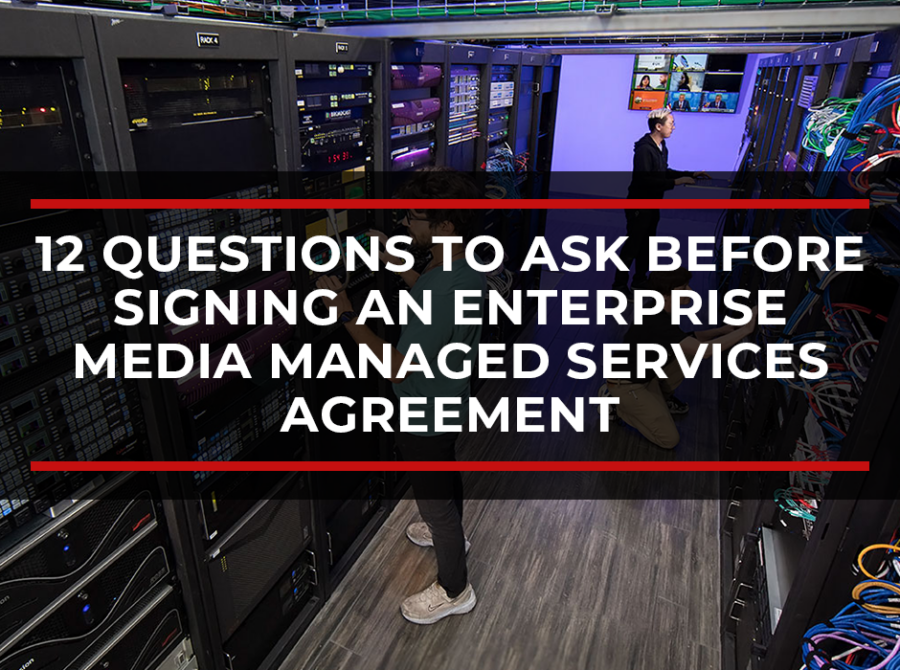
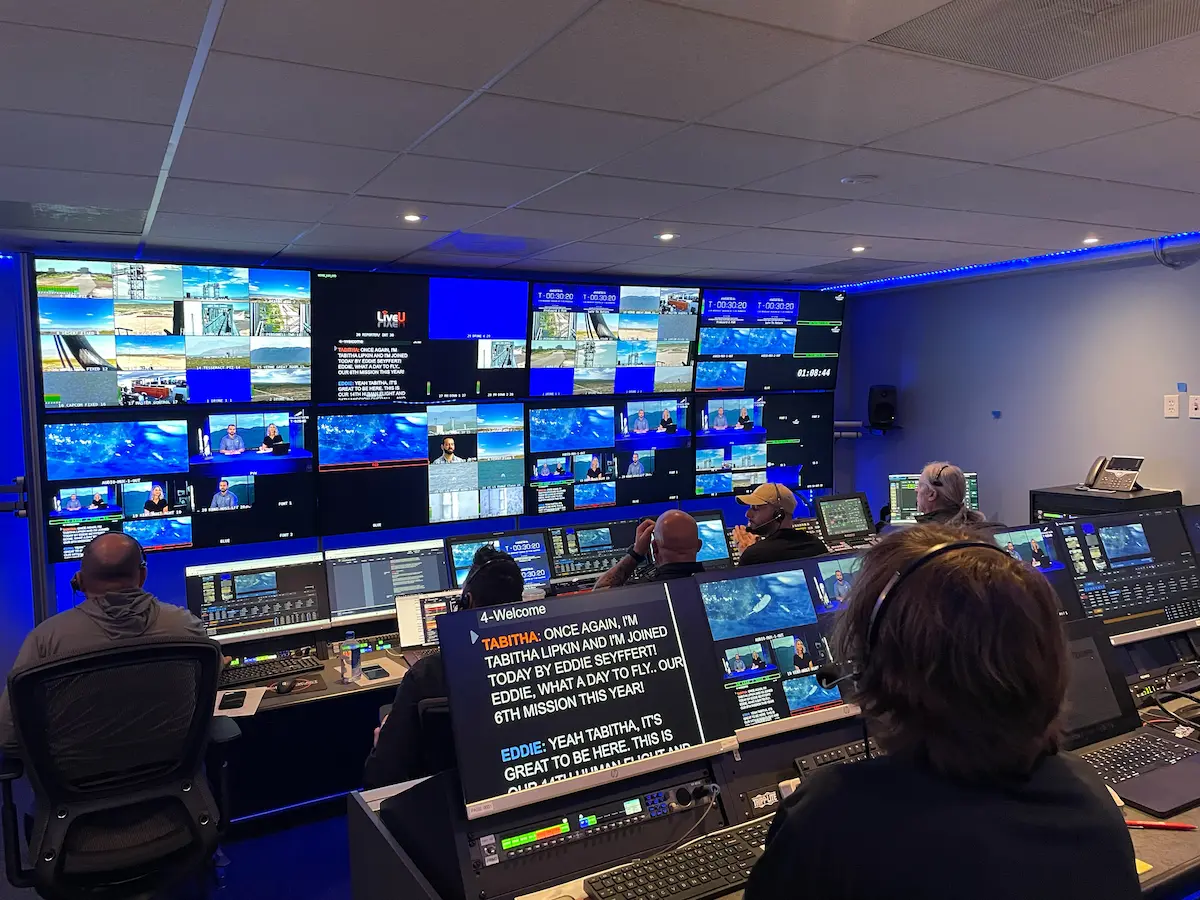
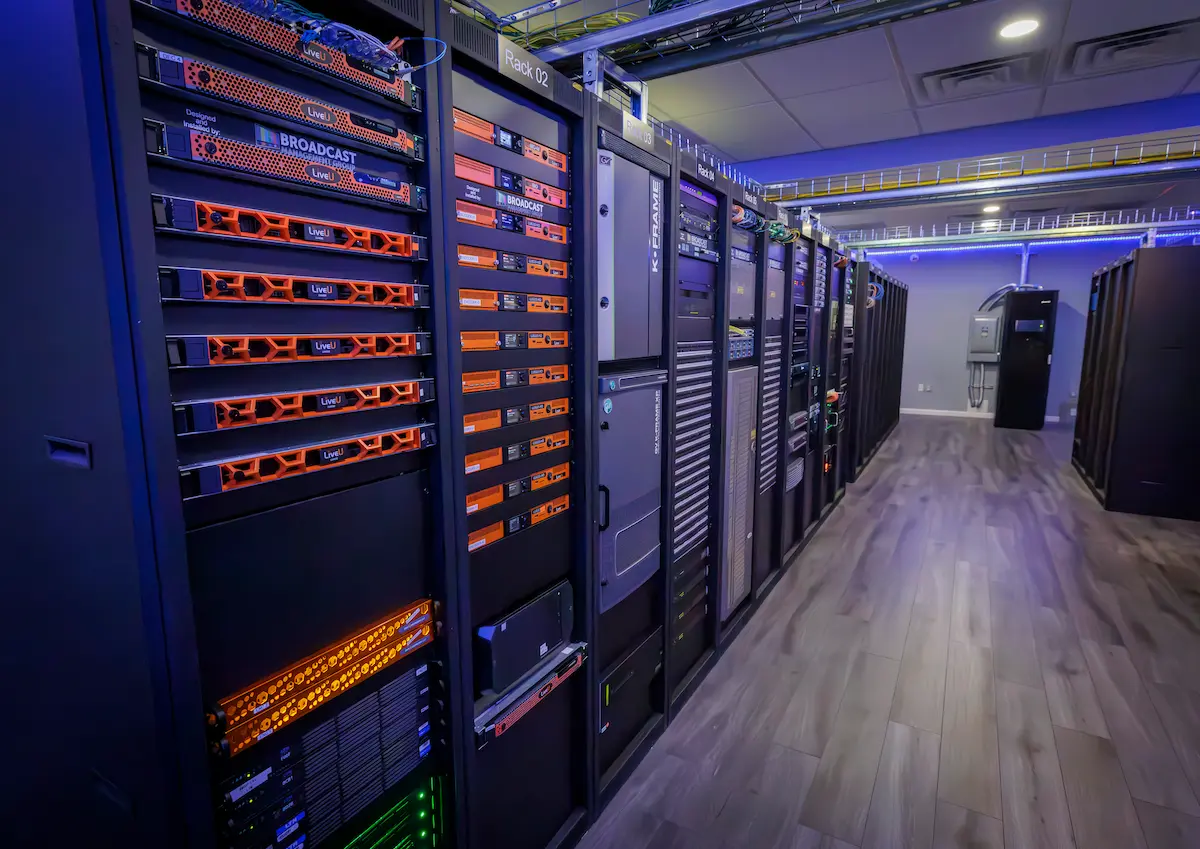
BMG’s Cloud Control Center provides exactly that operational layer. The facility runs 60+ inbound paths with redundant connectivity, supporting live production, MAM, archive, ingest, and end-to-end channel delivery for global broadcasters, FAST and OTT services, sports organizations, and enterprise video clients. Platform integrations span Roku, Samsung TV Plus, Pluto TV, Tubi, Peacock, and Amazon Freevee, meaning the operational team managing the broadcast chain also oversees the delivery relationships with the platforms that carry the content.
New channels can be launched in as little as 60 days from operational commitment to live air. That timeline reflects an infrastructure and workflow designed specifically to onboard new clients and channels without the procurement cycles and facility buildout that traditional broadcast operations require.
The question for any organization evaluating cloud broadcast operations is not whether cloud tools are available. It is who is running them at late at night when something goes wrong.
REMI Production – Remote Production as an Operational Model
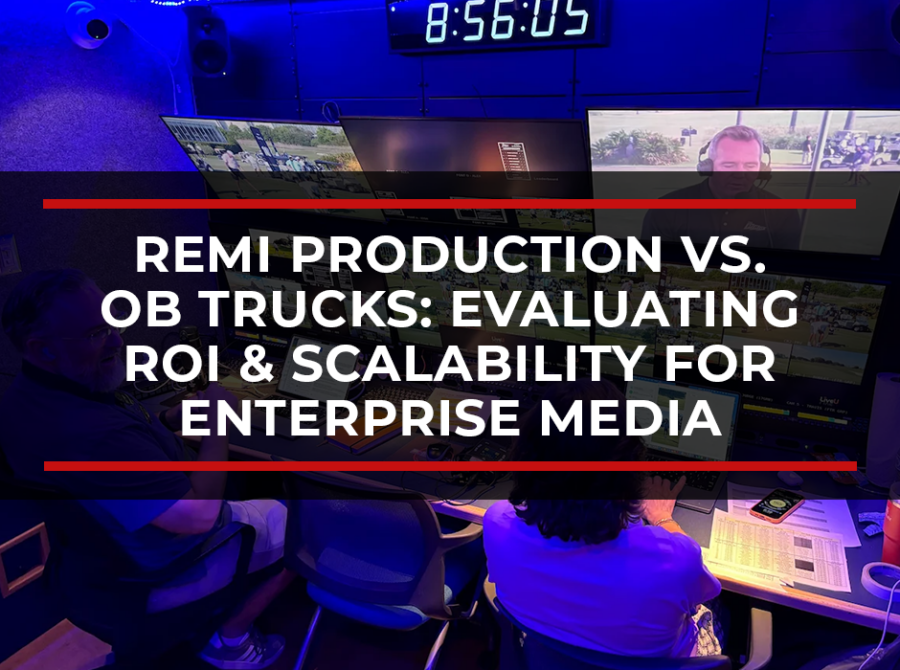
REMI the Remote Integration Model is a structured broadcast production architecture in which camera signals are transported from a venue to a centralized production hub via IP or fiber, where switching, audio mixing, graphics, and playback are handled remotely by an experienced production team.
REMI is not improvised. It is not “streaming from a laptop” or a cost-cutting measure that trades quality for convenience. It is a deliberate production architecture that, when properly executed, delivers broadcast-quality output at a fraction of the per-event cost of deploying a full production crew and control-room infrastructure at every venue.
The business case for REMI is built on three factors:
- Cost reduction – eliminating per-event crew travel, hotel, and per diem costs at scale
- Crew consolidation – centralizing experienced operators who can cover multiple events from the same hub.
- Coverage flexibility – reaching venues and locations where deploying traditional broadcast infrastructure would be logistically impractical or prohibitively expensive.
What REMI requires to work reliably is not optional: low-latency signal transport from the venue to the hub, robust centralized production infrastructure capable of handling multiple simultaneous inbound feeds, experienced remote operators with live-event discipline, and redundant connectivity paths with failover protocols tested before the event begins.
When REMI Is the Right Production Architecture
REMI is the right architecture for organizations with high-frequency live event schedules sports leagues covering dozens of venues across a season, corporate broadcast clients with recurring earnings calls or town halls, or any production operation where the cost of deploying full crews to every event is unsustainable at scale.
It is also the right architecture for geographically distributed venues that share a common production standard. When the same production team can cover events in three different states from a single centralized hub, the per-event economics change fundamentally.
The right question is not “can we do this over IP?” Almost anything can be transmitted over IP now. The right question is: does the production hub have the infrastructure, staffing, and operational discipline to manage inbound feeds from a venue reliably, at broadcast quality, under live-event pressure?
REMI in Practice: Three BMG Deployments
The difference between REMI as a concept and REMI as an operational reality is best illustrated by specific production environments.
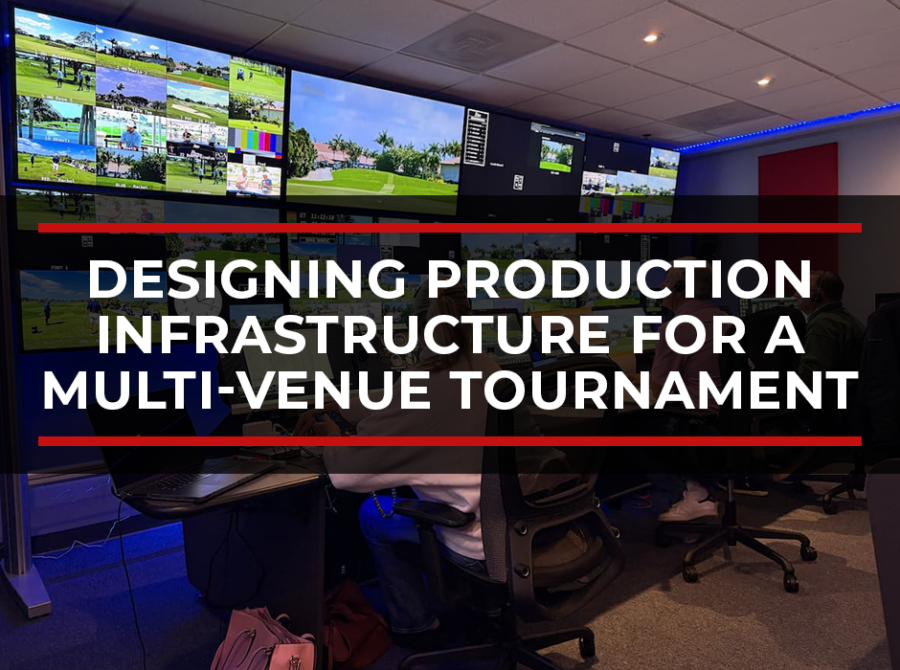
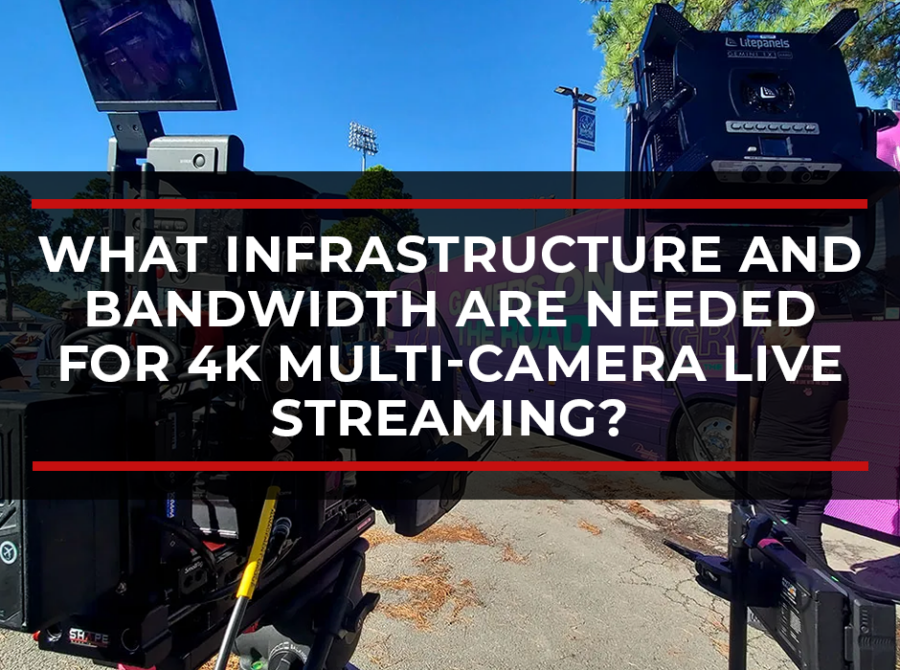
ProTour Golf. Broadcast Management Group (BMG) deployed a REMI truck on-site in Florida as the local point of presence, using on-site internet to return booth camera signals to the BMG NOC. Every camera on the course was connected to a LiveU backpack, transmitting directly to the NOC over cellular IP. This configuration delivered full-course coverage without the RF infrastructure that traditional golf broadcasts require, which routinely cannot reach on-course camera positions at all.
Above-the-line production crew operated entirely from the NOC. BMG simultaneously managed master control and playout for two diverse distribution platforms and handled remote editing within a single operational workflow.
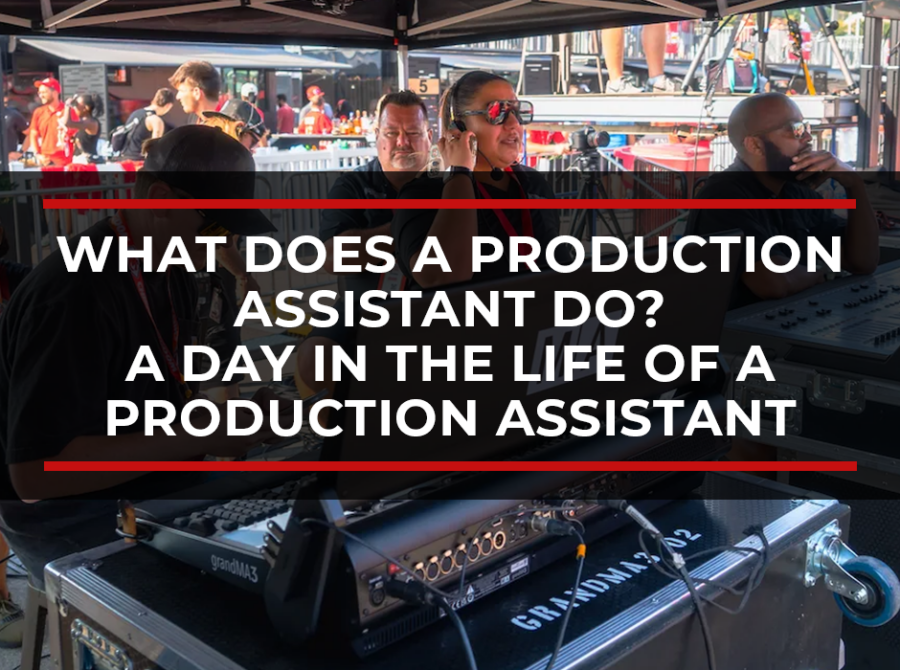
IMDb at Sundance. Venue space constraints at the Sundance Film Festival made a full production truck impractical. Broadcast Management Group (BMG) deployed a compact flight pack on-site for local signal acquisition, transmitting four camera feeds back to the NOC, where switching, audio mixing, graphics, and playback were handled centrally.
Talent IFB and client monitoring were provided remotely. The production team managed live streaming to two diverse platforms simultaneously with automated closed captioning integrated into the delivery workflow. This was a complete production and distribution operation with minimal physical footprint at the venue.
Blue Origin NG-3. A rocket launch demands a level of production complexity that few live events match. Broadcast Management Group (BMG) built an on-site video village in Florida for the client’s director and producer, with a studio and talent desk configured for live broadcast.
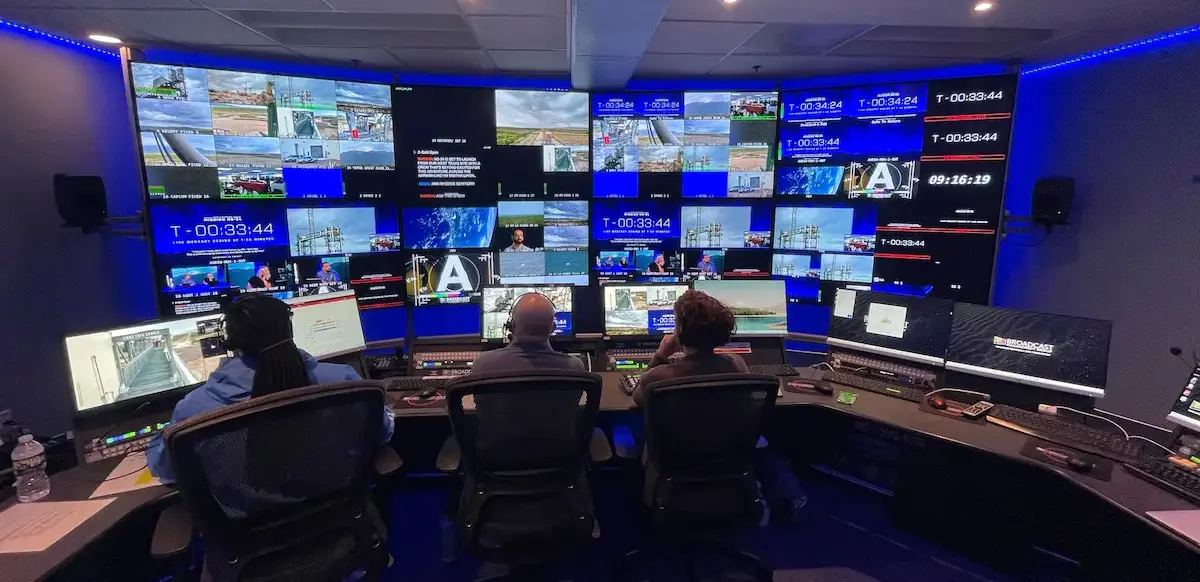
Remote ENG crews in Washington state and Alabama fed live content via LiveU to the BMG NOC. More than 50 inbound feeds all with associated audio were managed simultaneously at the NOC, with switching, production, and master control handled centrally while the client’s creative leadership maintained full directorial control from the Florida video village.
The result was a geographically distributed live production with the operational cohesion of a single centralized broadcast.
Integrating Cloud and REMI Into a Single Managed Broadcast Operation
Cloud infrastructure and REMI are complementary, not competing, production architectures. The convergence point is the NOC.
A cloud-based NOC provides the infrastructure: ingest, switching, playout, monitoring, and distribution that makes REMI production viable at scale. REMI feeds arrive at the NOC from venues across the country or the world. Cloud playout manages the channel output. Integrated monitoring gives the operations team a single, simultaneous view of every signal in the chain.
Distribution endpoints, including broadcast networks, CDN paths, and streaming platforms, are managed from the same operational environment. When this works, it looks like a single unified broadcast operation regardless of how distributed the underlying production is.
Cloud infrastructure and REMI converge at the NOC to create a unified production architecture. A cloud-based NOC provides the essential infrastructure—ingest, switching, playout, and distribution—that makes scaleable REMI production viable, offering a single view of the entire signal chain. When these systems are not designed as a coherent whole with established failover protocols and full-chain monitoring, the result is a failure in accountability.
Systems Integration as a Prerequisite
Deployments only become operational when underlying systems like IP routing and intercom are integrated and tested before a live event. Many organizations fail by treating these deployments as technology procurements rather than integration projects where the signal path, redundancy, and workflow are designed together.
Operational Staffing for End-to-End Broadcast Management
Systems Integration as a Prerequisite
Cloud and REMI deployments do not become operational broadcast infrastructure by default. They become operational when the underlying systems — IP signal routing, monitoring, intercom, backup connectivity, failover protocols — have been designed, integrated, and tested as a coherent system before a live event depends on them.
The organizations that experience the most failures in cloud and REMI environments consistently treat the deployment as a technology procurement rather than a systems integration project. The tools were acquired. The integration was assumed. The failure surfaced under live-event pressure, with no time to address it.
Proper systems integration means designing the signal path, the monitoring layer, the redundancy architecture, and the operational workflow together before any of them are tested by a live audience.
Operational Staffing for End-to-End Broadcast Management
The infrastructure decisions that enable cloud and REMI production are meaningless without the operational team to run them.
Centralized production hubs require experienced operators — engineers, production coordinators, playout technicians, and NOC supervisors who have worked under live-event pressure and understand how to respond when something deviates from the plan.
The common assumption that cloud infrastructure reduces the staffing requirement for broadcast operations is wrong. What it changes is where staff need to be and what they need to manage simultaneously.
A centralized cloud production hub that runs multiple channels and REMI feeds simultaneously requires more operational depth than a traditional single-channel control room — not less. The expertise requirement is higher. The consequence of a staffing gap is compounded across every channel and feeds the hub that manages.
The managed services model addresses this directly. Rather than hiring, training, and retaining the operational depth required for 24/7 broadcast management — a significant and ongoing organizational investment — broadcasters and rights holders outsource operational accountability to a partner with that depth already built and maintained.
What to evaluate in a managed broadcast partner is specific: 24/7 NOC coverage with documented escalation paths, technical depth across the full broadcast chain (not just playout, not just production), multi-platform delivery experience across the distribution endpoints your operation requires, and a track record of REMI and cloud production at the scale and event complexity your programming demands.
The Operational Architecture Decision
End-to-end broadcast management is not a technology decision. The technology cloud infrastructure, REMI transport, IP signal workflows, and integrated monitoring are mature enough to be treated as operational standards rather than emerging experiments.
The decision is who manages the operation. Who has eyes on the full signal chain at 2 a.m. Who has the authority and the infrastructure to respond when a REMI feed drops, a playout system misses a segment, or a CDN path degrades under load? Who is accountable not for one vendor’s component of the chain, but for the viewer’s signal at the end of it?
That accountability is what end-to-end broadcast management actually means. It is what separates a collection of capable broadcast tools from a broadcast operation you can rely on.
BMG manages that operation for global broadcasters, sports rights holders, content owners, and enterprise video clients — from systems integration and infrastructure design through live production, cloud playout, and 24/7 managed operations. If you are building, rebuilding, or evaluating your broadcast chain and need to understand what the operational architecture actually requires, that is the conversation we are built for.gned to work together under a single operational model. End-to-end broadcast management exists to close those gaps.
“End-to-end broadcast management” is a phrase that gets used often and defined rarely. It shows up in RFPs, vendor pitches, and strategy decks. Everyone claims to offer it. Far fewer actually deliver it because delivering it requires operational accountability across the entire broadcast chain: from the moment a camera goes live at a venue to the moment a viewer receives a clean signal on whatever platform they are watching.
That accountability gap between what technology can enable and what an operational team can reliably execute is exactly what cloud production and REMI have changed. Not by making the chain simpler. By making it possible to manage the chain more intelligently, with centralized oversight, distributed infrastructure, and a single point of accountability, point-solution vendors have never been able to provide.
Here is what that looks like in practice for organizations like Broadcast Management Group (BMG).
What the End-to-End Broadcast Chain Looks Like
A broadcast chain is a sequence of operational stages, each of which must execute cleanly for the viewer to receive a signal worth watching:
Signal acquisition — cameras, microphones, graphics sources, and remote feeds are captured at the venue or studio. This is where the content originates.
Production — the raw signals are mixed, switched, and shaped into a program. Switching, audio mixing, graphics, replay, and intercom are all production-layer functions.
Master control and playout — the program feed is scheduled, conditioned, and prepared for distribution. Ad insertion, branding, closed captioning, and compliance functions live here.
Distribution and delivery — the conditioned signal is delivered to its endpoint: a broadcast network, a CDN, a streaming platform, a satellite uplink, or all of the above simultaneously.
In a traditional broadcast operation, each of these stages was staffed and managed separately, often by different vendors, different teams, or different departments within the same organization.
The result was a chain with multiple handoff points, no single owner of the end-to-end signal path, and no unified operational view of the entire workflow.
That structure produced a specific, predictable failure mode.
Where Most Operational Failures Occur
When something goes wrong in a multi-vendor broadcast chain, the first question is almost never “what broke?” It is “who is responsible for this segment of the signal path?” By the time that question is answered, the event is still on air, or it is not.
The most common fragmentation points are consistent across broadcast operations assessments: multiple vendors with overlapping but undefined responsibilities, no unified NOC visibility across the full chain, and escalation paths that exist on paper but have never been tested under live-event pressure.
The vendor who manages your encoder points at the CDN. The CDN points at the playout system. The playout system operator did not know there was an issue at the encoder. No single team has eyes on the full picture at once.
End-to-end broadcast management is not a technology solution to this problem. It is an operational architecture solution. The technology including cloud infrastructure, REMI workflows, integrated monitoring enables it. But what closes the gap is a single operational team with visibility across the entire chain and accountability for it all.
Cloud Production – What It Is and What It Changes
Cloud production in a broadcast context is not the same thing as moving files to a storage bucket or running software on a remote server. In broadcast-specific terms, it means deploying IP signal workflows and software-defined infrastructure that allows production and playout functions including switching, graphics, monitoring, master control to operate from centralized, cloud-hosted environments rather than dedicated on-premise control rooms.
What moves to the cloud: switching and production control, graphics and branding systems, monitoring and signal verification, master control and playout, MAM and archive access, ingest management, and channel delivery functions.
What typically remains on-premise or hybrid: studio acquisition infrastructure, certain live ingest paths where latency or signal integrity requirements favor local processing, and transmission gear in specialized facilities.
The operational impact is significant. Infrastructure that previously required a purpose-built control room with dedicated hardware, co-located staff, and significant capital investment can now be deployed, managed, and monitored from a centralized cloud environment.
A broadcaster running a single channel from a traditional control room and a broadcaster managing twenty channels from a cloud operations center are operating fundamentally different business models, even if their on-screen output looks identical.
Cloud Production vs. Traditional Control Room Infrastructure
The shift from traditional control room to cloud production is not simply a technology upgrade. It is a change in the underlying economic model.
Traditional broadcast infrastructure is a capex model: large upfront investment in dedicated hardware, facility infrastructure, and proprietary systems, depreciated over a long refresh cycle. Capacity is fixed at the time of purchase. Adding a channel or scaling for a major event requires capital expenditure and lead time.
Cloud broadcast infrastructure is an opex model: infrastructure is provisioned on demand, scaled as needed, and paid for as an operational expense rather than a capital commitment. A channel launch that would have required months of facility buildout and equipment procurement can now be executed in weeks.
The staffing model changes as well. In a traditional control room, operators are co-located with the equipment they are running. In a cloud production environment, operators can be centralized in a single hub regardless of where the content originates or where the viewer is located.
That centralization enables multi-channel and multi-event operations that would require prohibitive staffing levels in a traditional model a single experienced operator can monitor and manage multiple channels simultaneously when the infrastructure gives them unified visibility across all of them.
Managed Cloud Broadcast Operations
There is a meaningful difference between having access to cloud broadcast tools and having a managed cloud broadcast operation.
Cloud tools software-defined switchers, cloud playout platforms, remote monitoring dashboards — are available from dozens of vendors. Deploying them is a procurement decision.
Operationalizing them staffing the NOC, building the escalation paths, establishing redundancy protocols, integrating delivery endpoints, and maintaining 24/7 accountability for everything the tools touch is a managed services decision.
BMG’s Cloud Control Center provides exactly that operational layer. The facility runs 60+ inbound paths with redundant connectivity, supporting live production, MAM, archive, ingest, and end-to-end channel delivery for global broadcasters, FAST and OTT services, sports organizations, and enterprise video clients. Platform integrations span Roku, Samsung TV Plus, Pluto TV, Tubi, Peacock, and Amazon Freevee meaning the operational team managing the broadcast chain also manages the delivery relationships with the platforms carrying the content.
New channels can be launched in as little as 60 days from operational commitment to live air. That timeline reflects an infrastructure and workflow that has been designed specifically to onboard new clients and new channels without the procurement cycles and facility buildout that traditional broadcast operations require.
The question for any organization evaluating cloud broadcast operations is not whether cloud tools are available. It is who is running them at late at night when something goes wrong.
REMI Production – Remote Production as an Operational Model
REMI the Remote Integration Model is a structured broadcast production architecture in which camera signals are transported from a venue to a centralized production hub via IP or fiber, where switching, audio mixing, graphics, and playback are handled remotely by an experienced production team.
REMI is not improvised. It is not “streaming from a laptop” or a cost-cutting measure that trades quality for convenience. It is a deliberate production architecture that, when properly executed, delivers broadcast-quality output at a fraction of the per-event cost of deploying a full production crew and control room infrastructure to every venue.
The business case for REMI is built on three factors:
- Cost reduction – eliminating per-event crew travel, hotel, and per diem costs at scale
- Crew consolidation – centralizing experienced operators who can cover multiple events from the same hub.
- Coverage flexibility – reaching venues and locations where deploying traditional broadcast infrastructure would be logistically impractical or prohibitively expensive.
What REMI requires to work reliably is not optional: low-latency signal transport from venue to hub, robust centralized production infrastructure capable of handling multiple simultaneous inbound feeds, experienced remote operators with live-event discipline, and redundant connectivity paths with failover protocols that have been tested before the event begins.
When REMI Is the Right Production Architecture
REMI is the right architecture for organizations with high-frequency live event schedules sports leagues covering dozens of venues across a season, corporate broadcast clients with recurring earnings calls or town halls, or any production operation where the cost of deploying full crews to every event is unsustainable at scale.
It is also the right architecture for geographically distributed venues that share a common production standard. When the same production team can cover events in three different states from a single centralized hub, the per-event economics change fundamentally.
The right question is not “can we do this over IP?” Almost anything can be transmitted over IP now. The right question is: does the production hub have the infrastructure, staffing, and operational discipline to manage inbound feeds from a venue reliably, at broadcast quality, under live-event pressure?
REMI in Practice: Three BMG Deployments
The difference between REMI as a concept and REMI as an operational reality is best illustrated by specific production environments.
ProTour Golf. Broadcast Management Group (BMG) deployed a REMI truck on-site in Florida as the local point of presence, using on-site internet to return booth camera signals to the BMG NOC. Every camera on the course was connected to a LiveU backpack, transmitting directly to the NOC over cellular IP. This configuration delivered full-course coverage without the RF infrastructure that traditional golf broadcast requires and that routinely cannot reach on-course camera positions at all.
Above-the-line production crew operated entirely from the NOC. BMG simultaneously managed master control and playout to two diverse distribution platforms and handled remote editing within the same operational workflow.
IMDb at Sundance. Venue space constraints at the Sundance Film Festival made a full production truck impractical. Broadcast Management Group (BMG) deployed a compact flight pack on-site for local signal acquisition, transmitting four camera feeds back to the NOC where switching, audio mixing, graphics, and playback were handled centrally.
Talent IFB and client monitoring were provided remotely. The production team managed live streaming to two diverse platforms simultaneously with automated closed captioning integrated into the delivery workflow. This was a complete production and distribution operation with minimal physical footprint at the venue.
Blue Origin NG-3. A rocket launch demands a level of production complexity that few live events match. Broadcast Management Group (BMG) built an on-site video village in Florida for the client’s director and producer, with a studio and talent desk configured for live broadcast.
Remote ENG crews in Washington state and Alabama fed live content via LiveU to the BMG NOC. More than 50 inbound feeds all with associated audio were managed simultaneously at the NOC, with switching, production, and master control handled centrally while the client’s creative leadership maintained full directorial control from the Florida video village.
The result was a geographically distributed live production with the operational cohesion of a single centralized broadcast.
Integrating Cloud and REMI Into a Single Managed Broadcast Operation
Cloud infrastructure and REMI are complementary, not competing, production architectures. The convergence point is the NOC.
A cloud-based NOC provides the infrastructure: ingest, switching, playout, monitoring, and distribution that makes REMI production viable at scale. REMI feeds arrive at the NOC from venues across the country or the world. Cloud playout manages the channel output. Integrated monitoring gives the operations team a single, simultaneous view of every signal in the chain.
Distribution endpoints, including broadcast networks, CDN paths, and streaming platforms, are managed from the same operational environment. When this works, it looks like a single unified broadcast operation regardless of how distributed the underlying production is.
Cloud infrastructure and REMI converge at the NOC to create a unified production architecture. A cloud-based NOC provides the essential infrastructure—ingest, switching, playout, and distribution—that makes scaleable REMI production viable, offering a single view of the entire signal chain. When these systems are not designed as a coherent whole with established failover protocols and full-chain monitoring, the result is a failure in accountability.
Systems Integration as a Prerequisite
Deployments only become operational when underlying systems like IP routing and intercom are integrated and tested before a live event. Many organizations fail by treating these deployments as technology procurements rather than integration projects where the signal path, redundancy, and workflow are designed together.
Operational Staffing for End-to-End Broadcast Management
Systems Integration as a Prerequisite
Cloud and REMI deployments do not become operational broadcast infrastructure by default. They become operational when the underlying systems — IP signal routing, monitoring, intercom, backup connectivity, failover protocols — have been designed, integrated, and tested as a coherent system before a live event depends on them.
The organizations that experience the most failures in cloud and REMI environments consistently treat the deployment as a technology procurement rather than a systems integration project. The tools were acquired. The integration was assumed. The failure surfaced under live-event pressure, with no time to address it.
Proper systems integration means designing the signal path, the monitoring layer, the redundancy architecture, and the operational workflow together before any of them are tested by a live audience.
Operational Staffing for End-to-End Broadcast Management
The infrastructure decisions that enable cloud and REMI production are meaningless without the operational team to run them.
Centralized production hubs require experienced operators — engineers, production coordinators, playout technicians, and NOC supervisors who have worked under live-event pressure and understand how to respond when something deviates from the plan.
The common assumption that cloud infrastructure reduces the staffing requirement for broadcast operations is wrong. What it changes is where staff need to be and what they need to manage simultaneously.
A centralized cloud production hub that runs multiple channels and REMI feeds simultaneously requires more operational depth than a traditional single-channel control room — not less. The expertise requirement is higher. The consequence of a staffing gap is compounded across every channel and feeds the hub that manages.
The managed services model addresses this directly. Rather than hiring, training, and retaining the operational depth required for 24/7 broadcast management — a significant and ongoing organizational investment — broadcasters and rights holders outsource operational accountability to a partner with that depth already built and maintained.
What to evaluate in a managed broadcast partner is specific: 24/7 NOC coverage with documented escalation paths, technical depth across the full broadcast chain (not just playout, not just production), multi-platform delivery experience across the distribution endpoints your operation requires, and a track record of REMI and cloud production at the scale and event complexity your programming demands.
The Operational Architecture Decision
End-to-end broadcast management is not a technology decision. The technology — cloud infrastructure, REMI transport, IP signal workflows, integrated monitoring — is mature enough to be treated as an operational standard rather than an emerging experiment.
The decision is who manages the operation. Who has eyes on the full signal chain at 2 a.m. Who has the authority and the infrastructure to respond when a REMI feed drops, a playout system misses a segment, or a CDN path degrades under load. Who is accountable not for one vendor’s component of the chain, but for the viewer’s signal at the end of it.
That accountability is what end-to-end broadcast management actually means. It is what separates a collection of capable broadcast tools from a broadcast operation you can rely on.
BMG manages that operation for global broadcasters, sports rights holders, content owners, and enterprise video clients — from systems integration and infrastructure design through live production, cloud playout, and 24/7 managed operations. If you are building, rebuilding, or evaluating your broadcast chain and need to understand what the operational architecture actually requires, that is the conversation we are built for.

Andrew Ryback is the Executive Vice President of Production. He brings over 17 years of experience in production management across live events, entertainment, and on-location shoots. He has managed production logistics for high-profile events, including The Emmys, The Oscars, TIFF, SXSW, Comic-Con, New York Fashion Week, Sundance, and both national political conventions. At BMG, he oversees complex productions from crew and equipment coordination to budgeting, permitting, and on-site execution.
About Andrew Ryback