Live sports streaming production starts long before game day with decisions that determine whether the broadcast will succeed or fail.
For teams building live sports productions from the ground up, this scenario, where a problem emerges right before the game is about to go live, is more common than many would like to admit.
The pressure of live sports leaves little room for improvisation when systems fail. There are no second takes, no editing fixes, and no opportunity to redo a missed shot.
Every camera feed, transport path, encoder, and delivery endpoint must work together flawlessly in real time.
Success comes from making the right architectural decisions before the first camera is deployed and before the game clock starts.
This guide breaks down every layer of a live sports streaming production workflow, from signal acquisition and transport to production control, encoding, distribution, and monitoring, highlighting the decisions and strategies that separate broadcast-quality productions from costly failures.
SECTION 1: Start With the Event Architecture, Not the Gear
Before selecting cameras, encoders, switchers, or transport solutions, production teams must understand the event’s requirements.
Every technical decision should be informed by a defined event architecture.
Key planning questions include:
- How many cameras will be required?
- Will the production utilize fixed cameras, PTZ cameras, handheld cameras, or a combination?
- How many simultaneous feeds or streams are needed?
- Where will the content be delivered—broadcast television, OTT platforms, social media, or multiple destinations?
- What latency requirements must be met?
- What infrastructure already exists at the venue?
- Will the production be fully self-contained or leverage venue resources?
The answers to these questions determine camera counts, transport methods, staffing requirements, production workflows, encoding profiles, and distribution strategies.
If multiple events are happening concurrently, companies should review schedules and timing to ensure proper staffing and equipment allocation.
Gathering this information upfront allows us to build the right production plan, assign the appropriate resources, and develop an accurate budget.
Reliability is created during the planning phase. If resiliency is not designed into the architecture from the beginning, it becomes significantly more difficult to achieve later.
SECTION 2: Signal Acquisition — Building the Camera Chain
Every live sports production begins with signal acquisition.
Capturing the action requires matching multi-camera systems to the demands of the sport, venue, and viewing experience.
When the budget allows, adding additional cameras significantly enhances production value by providing more replay angles, tighter player coverage, and greater storytelling opportunities.
Camera selection is generally driven by three factors:
- Mobility requirements
- Latency tolerance
- Integration with the production environment
Common camera roles include:
- Fixed Cameras – provide consistent wide shots, game coverage, scoring zones, and primary program angles.
- PTZ Cameras – offer remotely controlled coverage and can significantly reduce staffing requirements while expanding the number of available camera positions.
- Handheld Cameras – Handheld and ENG-style cameras provide dynamic coverage from sidelines, player entrances, locker rooms, and field-level positions.
- POV and Specialty Cameras – Action cameras and POV systems deliver unique perspectives that can enhance viewer engagement and create premium content opportunities.
Lens selection is equally important. Larger stadiums often require zoom lenses that maintain image quality at long distances, while smaller venues may need standard lens packages.
Production teams must also determine the most appropriate signal transport method within the venue:
- SDI for traditional broadcast environments
- HDMI for smaller productions
- NDI and IP-based workflows for networked production infrastructures
Each option presents different tradeoffs related to distance, reliability, flexibility, and cost.
SECTION 3: Contribution & Transport — Getting the Signal from Venue to Production
Once camera signals are captured, they must be transported reliably to the production environment.
This stage is where live sports productions experience their greatest technical risks.
At Broadcast Management Group (BMG), LiveU bonded cellular technology is the backbone of our REMI productions, delivering broadcast-quality video to our Network Operations Center (NOC) with latency measured in milliseconds.
Several transport methods are commonly used for other organizations:
Dedicated Fiber
Fiber circuits remain the standard for reliability and performance. They provide predictable bandwidth and low latency, but can be expensive and unavailable at certain venues.
Bonded Cellular
Solutions such as LiveU, TVU, and Dejero combine multiple cellular connections to create resilient transport paths. These systems have become popular due to their flexibility and rapid deployment capabilities.
SRT Over Public Internet
Secure Reliable Transport (SRT) provides an efficient and cost-effective option for many sports productions. When supported by proper network management and quality-of-service planning, SRT can deliver excellent results.
Satellite Uplink
Satellite remains a critical option for remote venues where terrestrial connectivity is unavailable or insufficient.
Transport protocols also matter. SRT, RIST, and RTMP each offer distinct capabilities in latency, packet recovery, security, and reliability.
One principle remains constant regardless of the transport technology selected:
Never rely on a single transport path.
Professional sports productions should always include at least a primary and backup path.
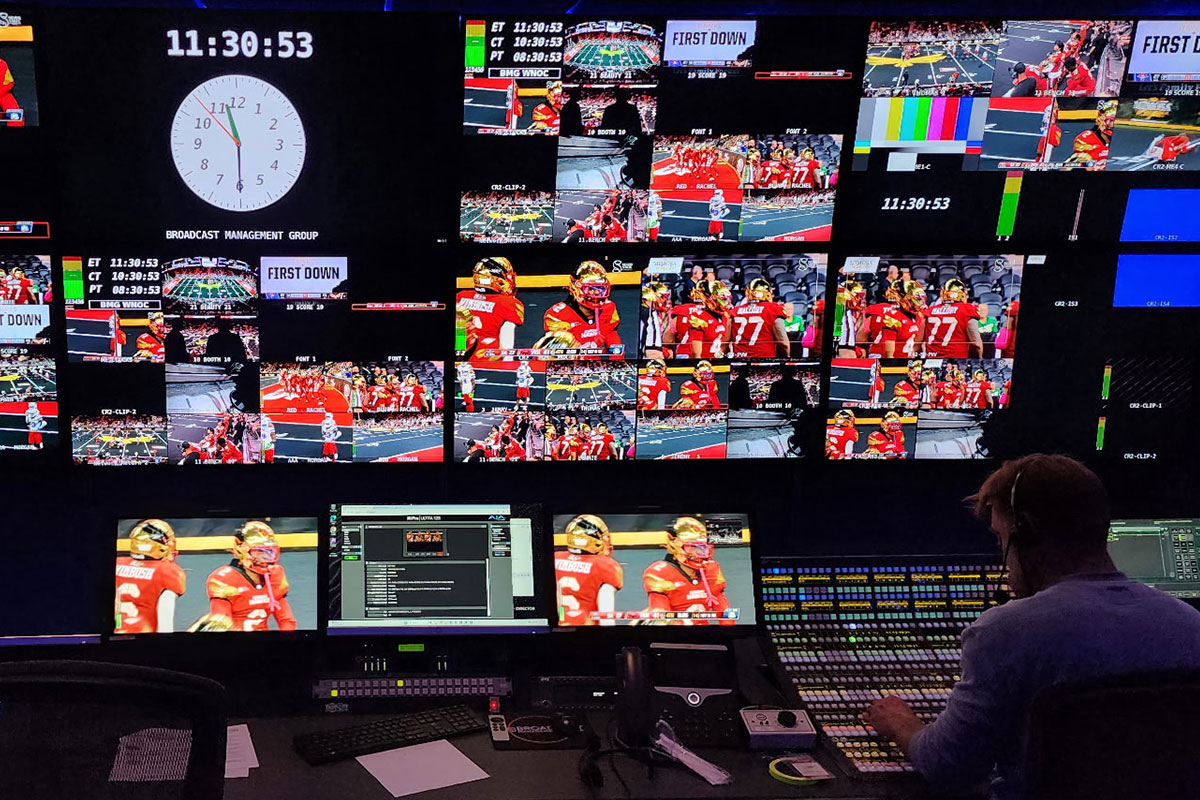
SECTION 4: The Production Control Layer — Switching, Graphics, and Audio
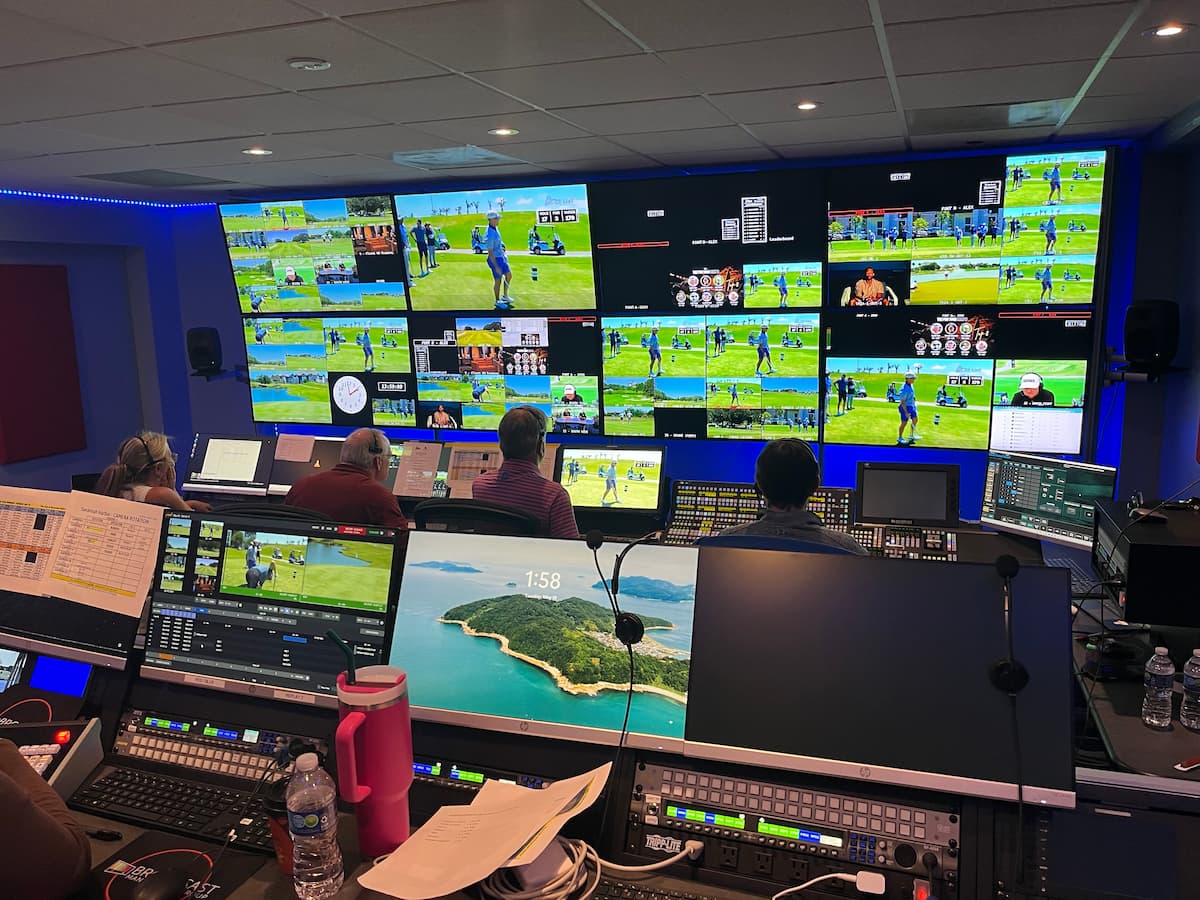
The production control layer is where feeds become a complete broadcast.
This environment combines cameras, graphics, audio, replay, and communications systems into a workflow capable of producing a live event.
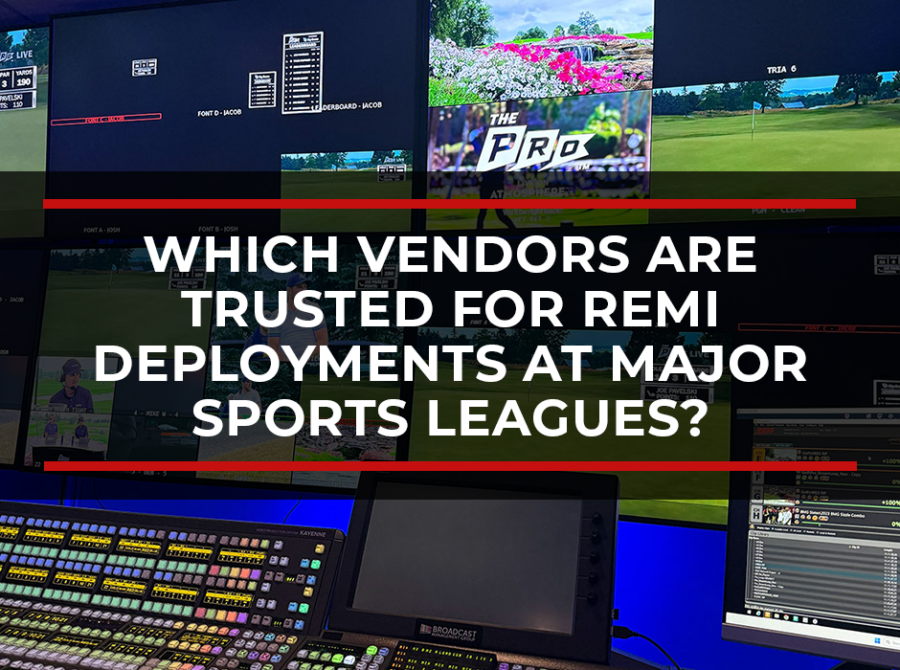
At Broadcast Management Group (BMG), we primarily deploy Grass Valley Kayenne production switchers, with Ross Acuity switchers available depending on production needs.
For graphics, we rely on Ross XPression to create scoreboards, lower thirds, sponsorship elements, player statistics, and other on-screen graphics that keep viewers informed and engaged.
Core components of production workflows include:
Production Switcher
The production switcher serves as the center of the control room. The switcher allows the technical director to manage all incoming video sources and create the final program output.
Graphics Systems
Graphics systems generate scoreboards, lower thirds, sponsorship elements, player statistics, and other visual enhancements that provide context and value to viewers.
Audio Console
Crowd noise, commentary, effects microphones, and venue audio must be balanced carefully to create an immersive viewing experience.
Replay Systems
Replay technology enables slow-motion review, highlight creation, and instant playback, features that viewers now expect from virtually every sports broadcast.
Intercom and IFB
Reliable communication between production personnel is essential. Intercom systems and IFB workflows ensure that directors, camera operators, announcers, and technical staff are coordinated throughout the event.
Production teams must also determine whether the control layer will be:
- Fully on-site
- Centrally managed through a REMI workflow
- Cloud-based
- A hybrid combination of all three
Staffing considerations typically include:
- Technical Director
- Graphics Operator
- Audio Engineer
- Replay Operator
- Producer
- Director
The model depends on event scale, budget, location, and operational goals.
SECTION 5: Encoding & Packaging — Preparing the Stream for Delivery
After production is complete, the final program feed must be encoded and packaged for distribution.
Encoding converts the production output into streaming formats suitable for viewers across a wide range of devices and network conditions.
Key considerations include:
Codec Selection
- H.264 for broad compatibility
- H.265/HEVC for improved efficiency
- AV1 for emerging next-generation delivery workflows
Adaptive Bitrate Profiles
A bitrate ladder allows viewers to receive the highest quality stream their connection can support.
Resolution and Frame Rate
Production teams must determine the appropriate combination of:
- 1080i
- 1080p
- 4K
Along with frame rates such as:
- 30fps
- 50fps
- 60fps
Hardware vs. Software Encoding
Each approach presents unique tradeoffs related to latency, quality, scalability, and cost.
As with every stage of the workflow, redundancy remains essential. Independent encoding paths ensure uninterrupted delivery if a primary encoder experiences an issue.
BMG tailors each delivery method to each broadcaster. For ESPN productions, we use Haivision encoders provided by the network. For other broadcasters and streaming platforms, we can deliver the program feed directly through our LiveU encoders or other in-house encoding solutions.
This flexibility allows us to meet a wide range of delivery specifications while ensuring a reliable, broadcast-quality transmission.
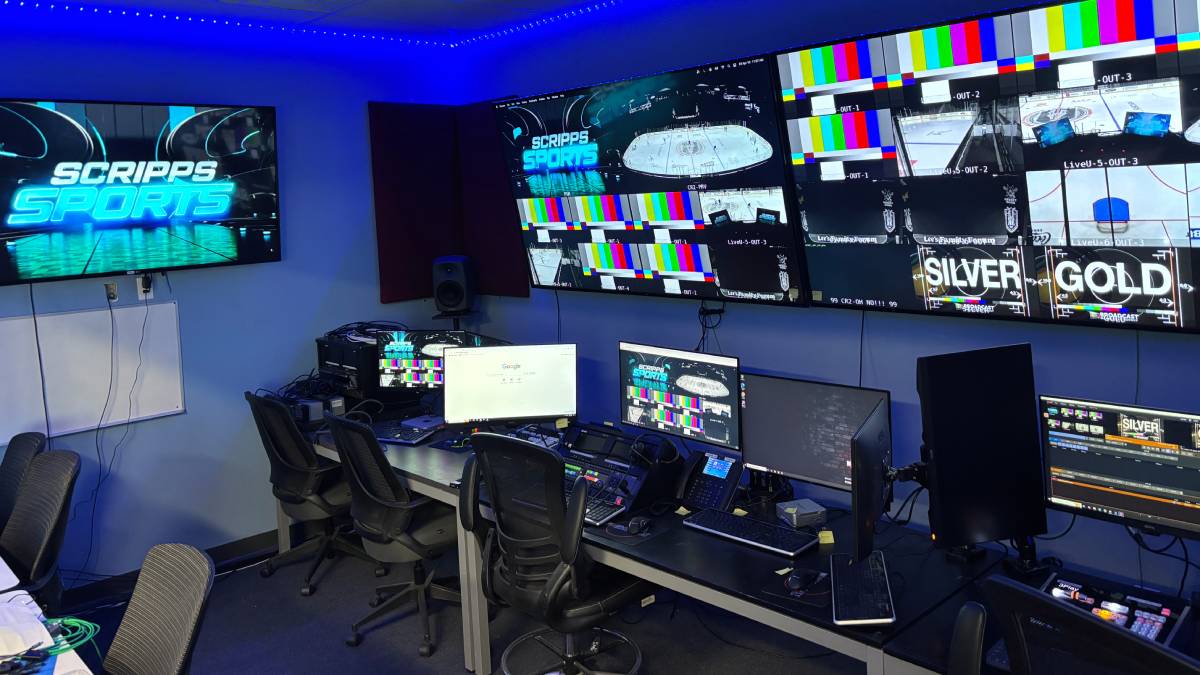
SECTION 6: Distribution & Delivery — Getting It to the Viewer
The final stage of the workflow is distribution.
Common destinations include:
Broadcast Networks
Program feeds may be delivered directly to television networks or regional sports broadcasters.
OTT Platforms
Many leagues and organizations now operate their own direct-to-consumer streaming platforms and applications.
Social Platforms
Simultaneous delivery to YouTube, Facebook, X, and other social platforms can significantly expand audience reach.
Venue Displays
Program feeds may also be routed to scoreboards, ribbon boards, and in-venue display systems.
Content delivery networks (CDNs) play a critical role in ensuring reliable playback. Factors such as geographic reach, redundancy, latency, and performance requirements all influence CDN selection.
Modern sports productions utilize multi-destination strategies, enabling a single production workflow to support multiple viewing platforms.
Latency expectations vary by platform:
- Broadcast: typically under 5 seconds
- OTT: often between 5–30 seconds
- Social platforms: frequently higher, though improving
SECTION 7: Monitoring, Redundancy & Failover — The Layer That Saves the Broadcast
A live sports streaming workflow is incomplete without comprehensive monitoring and a failover architecture.
This layer determines whether a technical issue becomes a minor incident or a visible outage.
Critical monitoring points include:
- Signal quality across all ingest points
- Encoder health and output status
- Audio levels and synchronization
- Transport path performance
- CDN and distribution health
- Origin server availability
Effective failover strategies follow several core principles:
Every Critical System Requires Backup
No single point of failure should exist within the workflow.
Failover Should Be Automated
Automatic failover reduces recovery times and eliminates dependence on manual operator intervention.
Testing Must Occur Before Event Day
Backup systems are only valuable if they have been tested under real-world conditions.
For larger productions, a Network Operations Center (NOC) provides an additional layer of protection by monitoring every stage of the workflow in real time.
With dedicated engineering oversight and proactive incident response, a NOC can often identify and resolve issues before viewers notice any impact.
Conclusion
Building a live sports streaming workflow is a systems design challenge, not a technology challenge.
Every layer of the workflow, from event architecture and signal acquisition to transport, production control, encoding, distribution, and monitoring, depends on the decisions made in the layers before it.
The organizations that consistently deliver successful sports broadcasts are the ones that invest in thoughtful workflow design, rigorous testing, and comprehensive redundancy planning.
Broadcast Management Group has designed, deployed, and managed live sports-streaming workflows for leagues, broadcasters, and live-event producers nationwide.
From initial architecture and production planning to 24/7 NOC monitoring and managed operations, BMG provides end-to-end support for reliable live event delivery.
Work with BMG to design and optimize your live sports production workflow.

Andrew Ryback is the Executive Vice President of Production. He brings over 17 years of experience in production management across live events, entertainment, and on-location shoots. He has managed production logistics for high-profile events, including The Emmys, The Oscars, TIFF, SXSW, Comic-Con, New York Fashion Week, Sundance, and both national political conventions. At BMG, he oversees complex productions from crew and equipment coordination to budgeting, permitting, and on-site execution.
About Andrew Ryback