For decades, broadcast operations required buying infrastructure yourself and hiring the engineering staff to run it.
This model made sense when there was no alternative, but ownership doesn’t end at the purchase.
It comes with ongoing maintenance, staffing, upgrades, and a 5-10 year replacement cycle, which was often sized for an organization’s busiest day rather than its average one.
For organizations producing live video, the question is whether the total cost of owning, staffing, and refreshing that environment still makes sense.
CapEx vs. OpEx: Reframing Broadcast as a Financial Decision, Not Just a Technical One
Broadcast infrastructure has traditionally been treated as an engineering decision: What gear to buy, which vendors to select, and how to design the control room. However, for finance leaders, it’s a capital allocation decision first.
Two Different Financial Models
The CapEx Model puts complete ownership onto the organization. This model includes a large upfront investment, depreciating assets, and the operating burden of staffing, maintaining, and refreshing your infrastructure long-term.
In the OpEx Model, organizations pay for broadcast-grade infrastructure, engineering support, and production staffing through a managed services partner, rather than doing it all internally.
Why the Shift Is Gaining Ground
Beyond the initial upfront cost differences, the OpEx model is providing other long-term benefits compared to the CapEx model:
- Predictability: Infrastructure, staffing, monitoring, and support are all a part of the service line, instead of scattered across budgets, headcount, and vendor contracts.
- Flexibility: Resources scale up or down with production volume instead of sitting fixed regardless of demand.
- Reduced Exposure: The risk of owning equipment that ages out shifts to the partner responsible for keeping the infrastructure up to date.
This decision doesn’t mean every asset needs to move out of your control. Core facilities, security-sensitive environments, and heavily used production spaces can still justify producing in-house. When making the decision, determine which parts of your operation should be done yourself or by a managed services provider.
This is the foundation for the ROI framework.
What Managed Services Save and Where
The ROI on managed services doesn’t come from just one area; it comes from several cost categories that a CapEx model forces organizations to carry in full, whether they’re used or not.
- Idle Capacity Cost: Infrastructure and staff that are sized for the biggest events sit underutilized for the rest of the year. Managed services turn this cost into a variable one, with capacity accessed by show, season, or event.
- Lifecycle Refresh Cost: Equipment depreciates on a 5-10 year cycle. Under the CapEx model, this becomes a recurring capital expense for the organization, while under the OpEx model, this cost is absorbed by the partner.
- Stranded Labor Cost: Specialized engineering roles are expensive to hire and keep fully utlized. When you carry that headcount permanently, you have to pay for capacity that isn’t always needed. A partner has a trained bench made for this volatility.
- Vendor and Integration Overhead: The CapEx model requires separate vendors for equipment, integration, staffing, and monitoring, while the OpEx model has one accountable partner.
- Budget Predictability: A bundled operating cost is easier to forecast than capital cycles with variable staffing and ad hoc vendor spend, reducing the planning burden and financial risk of emergencies.
When to Own, When to Outsource, and How to Decide
None of this is to say that CapEx should be eliminated entirely; rather, it argues to spend your budget wisely and in the right areas.
When Ownership Still Makes Sense
Some infrastructure justifies complete ownership: Core systems that are used daily, security-sensitive environments, and heavily utilized production spaces support the capital cost. For these spaces, having ownership gives organizations control where it matters most.
When Managed Services Wins
If your operation is sized to peak demand rather than daily use, a managed OpEx model converts those fixed costs and risk into variable, predictable costs. Some benefits of this model include:
- Specialized staffing
- Remote and event production
- Redundant infrastructure
- Technical support that scales with volume

UBS: Scaling Broadcast Operations While Reducing On-Site Costs
UBS is an example of how a managed services approach can help organizations scale broadcast operations while controlling overhead.
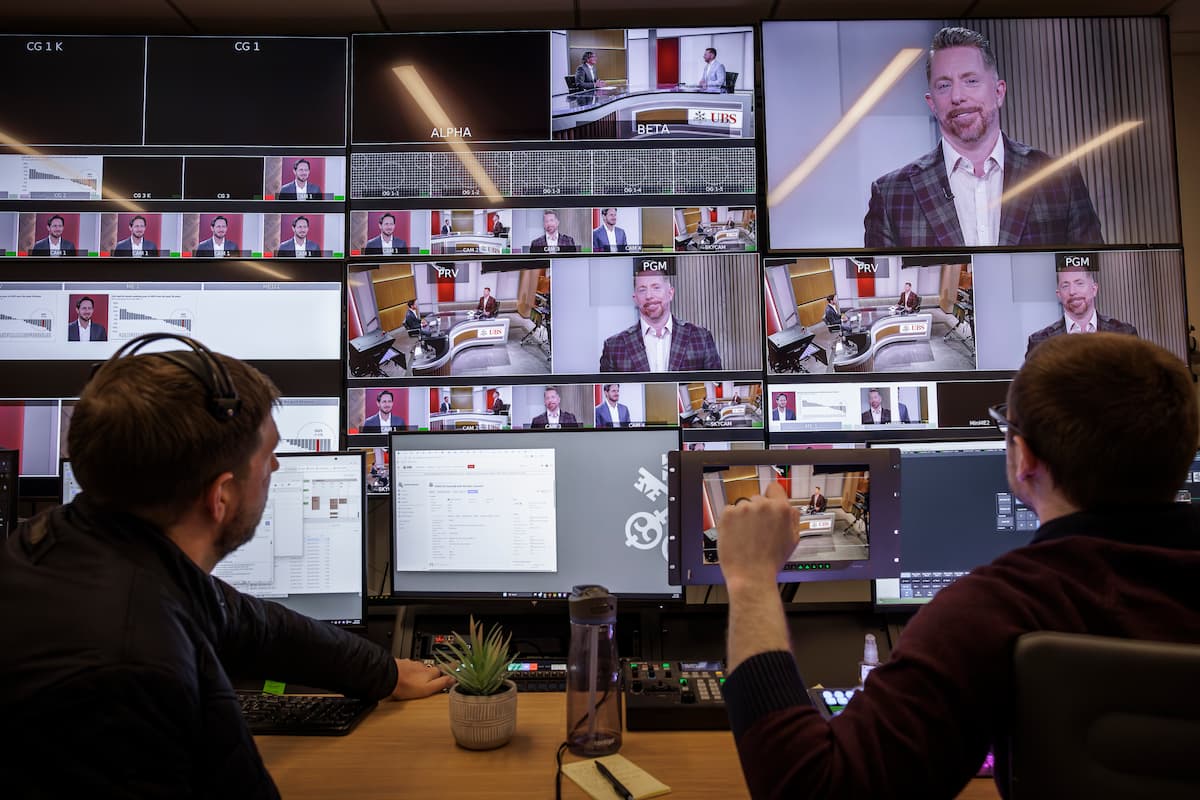
Through its partnership with BMG, UBS streamlined its production workflow by leveraging BMG’s engineering resources, broadcast infrastructure, and remote production capabilities. Rather than relying entirely on on-site personnel and infrastructure, UBS uses BMG’s support to extend its production capabilities while maintaining the technical reliability required for financial news and live programming.
The approach resulted in 40% fewer on-site staff, demonstrating how organizations can reduce staffing requirements while maintaining consistent production operations.
For organizations with recurring live programming, this highlights an important part of the ROI equation: outsourcing isn’t just about reducing infrastructure costs. It’s also about accessing specialized expertise and production resources without carrying the full expense of maintaining them internally.
A Decision Framework for Finance and Operations Leaders
Before your next infrastructure investment or contract renewal, a few questions can help clarify which parts of your operation should be done in-house and which should be outsourced:
- Is your infrastructure and staff used consistently, or only during peak periods?
- Is your environment going to need replacement within the next refresh cycle?
- Would losing a key specialist create a coverage gap that can’t be filled quickly?
- Do costs show up as a planned expense or an unbudgeted cost?
- If something fails during a live broadcast, is it clear who’s responsible for fixing the problem?
If your answers to these questions point toward volatility, underutilization, or fragmented accountability, then that’s a sign the part of your operation should be outsourced.
The strongest broadcast operations are the ones that match each part of the operation to the model that fits it based on their production needs. Own what’s used every day and outsource what’s needed sometimes. This is the strategy that the business case can be built around.
Rethinking Your Broadcast Operations?
The right broadcast strategy isn’t necessarily about owning everything or outsourcing everything. It’s about having the infrastructure, expertise, and support your operation needs without carrying unnecessary overhead.
BMG helps organizations build scalable broadcast operations through managed services, engineering support, and 24/7 Network Operations Center monitoring.
Explore BMG’s Managed Services or connect with our team to evaluate where outsourcing can improve efficiency, control costs, and support your long-term production needs.

Todd Mason is the Chief Executive Officer of Broadcast Management Group (BMG), a broadcast infrastructure and media operations company helping define the next generation of television production, live media operations, and broadcast network infrastructure in North America.
About Todd Mason