For years, the media asset management conversation has been framed as a binary choice: keep everything in your building or move it to the public cloud.
Both models carry costs that often surface only after deployment, and many broadcasters that went all-in on the public cloud are now shifting to hybrid or on-premise strategies to regain control of their budgets.
The better questions are: Where does your media need to live, how often will it move, and who’s going to operate it?
On-Premise MAM: Control at a Cost
- ✅ Full control over hardware, security, and data location
- ✅ High performance for editing high-bitrate media locally
- ❌ High upfront CapEx and recurring hardware refreshes
- ❌ Capacity built for peak demand that sits idle between events
- ❌ Limited remote access and a reliance on in-house staff for maintenance
- ❌ Unable to flex to meet high demand when needed
- ❌ Vulnerable to disaster unless parallel off-site capacity is established and maintained
On-premise still makes sense for facilities with steady, predictable workloads and in-house engineering teams.
Public Cloud MAM: Flexibility With a Meter Running
- ✅ Elastic scale without buying hardware
- ✅ Access from anywhere for distributed teams
- ❌ Egress and ingress fees on top of storage, compute, and management costs
- ❌ Unpredictable monthly spend, because live video moves constantly at high bitrates and general-purpose platforms bill for that movement
- ❌ Limited human support, even when you pay extra
- ❌ No control over updates, forcing you to chase problems with your connected devices to keep on track
- ❌ Each new feature comes with another bill
- ❌ High costs to retrieve your content and move to another platform later if your needs change, making you feel trapped
Why Hybrid Only Solves Part of the Problem
Many broadcasters are landing on hybrid: Tiered storage that keeps active content hot and moves the rest to archive, with editors working from proxies.
That helps, but it still leaves teams managing two environments, two cost models, and the integration between them.
The Third Option: A Private Broadcast Cloud
The BMG Cloud Control Center™ is a private, multi-tenant broadcast cloud built specifically for live production, post-production, MAM, playout, and master control, and was named a 2026 Global Tech Award winner in the Cloud Technology category.
Clients share infrastructure that’s larger and more redundant than any single organization would build. Capacity scales up for a launch or tournament and back down afterward, with no idle hardware and no metered charge every time a file moves.
What a Managed MAM Adds: BMG Media Command
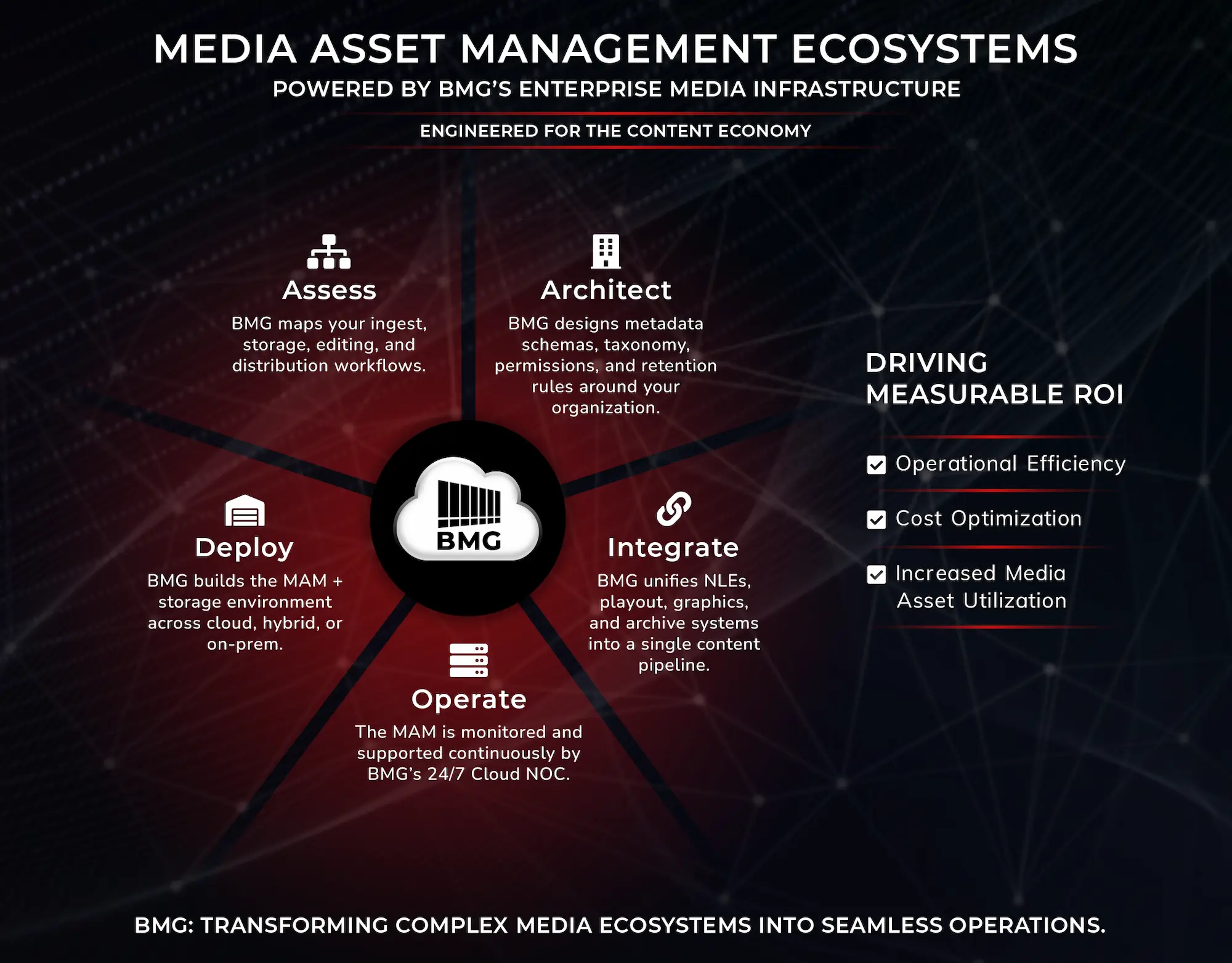
BMG’s recently launched Media Command brings recording, MAM, playout, archive, and compliance into one platform running in the Cloud Control Center™.
Benefits of BMG’s Media Command include:
- No duplicate files: Built on TAMS, an open API developed at BBC R&D, Media Command references media segments instead of copying them across editing, archive, proxy, and distribution.
- Isolated and secure: Each client’s capacity is isolated, media never sits in a public cloud region, and role-based access and audit trails support compliance-driven organizations.
- Predictable pricing: Clients choose an OpX monthly subscription with no upfront capital or usage charges, or a CapX model. Pricing is based on users, features, and storage, not on how often media moves.
Case Study: Virginia Public Media
The Cloud Control Center™ model is already in use. Virginia Public Media (VPM), the PBS and NPR affiliate serving Richmond, pairs on-site television, radio, and podcast production with a MAM hosted in the BMG Cloud Control Center™.
The platform supports secure archiving, retrieval, and content reuse across teams. Redundant dark fiber provides transmission continuity and disaster recovery, all supported through BMG’s 24/7 NOC.
Find the Right MAM Model for Your Operation
The right MAM model depends on how your content moves and how your team works.
Explore BMG’s Media Asset Management Services and Media Command, or take the free MAM Assessment to see where your current environment stands.

Karen Landry is Director of Master Control, Playout & Transmission at BMG. She brings over 20 years of experience across post-production, broadcast engineering, and client services, having supported major entertainment productions, live sports, and premier events, including the Super Bowl, the Olympics, and Amazon’s Thursday Night Football. In her current role, Karen partners with clients to develop and deliver cloud-based channel playout and transmission solutions that drive operational excellence.
About Karen Landry